Dive Brief:
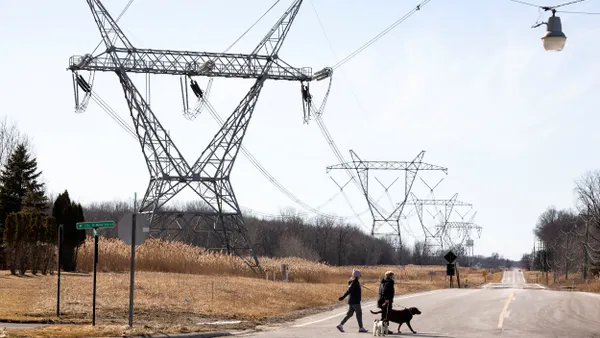
- The Western energy market is increasingly seeing south-to-north energy flow patterns, a reversal of historical precedent that may require systemic changes along with more accurate generation forecasts, said speakers at the Market Seams workshop hosted Tuesday by the California Independent System Operator and Southwest Power Pool.
- In order to protect grid stability in certain circumstances, the Western Interconnection can split along its north-south boundary, an automated response known as the WECC-1 RAS, for Remedial Action Scheme. But that approach does not consider the growth of south-to-north power flows, “and frankly, it is something I’m worried about,” Chris Sanford, a system dispatcher with Bonneville Power Administration, said during a Q&A portion of the workshop.
- “If we had a triple line loss on [the California-Oregon Intertie], God forbid, with 3,600 MW flowing south-to-north, I don't think California is prepared to deal with the loss of 3,600 MW of load,” Sanford said. “And I know that it would be a difficult exercise to respond to 3,600 MW loss of gen up in the Pacific Northwest. We still haven't solved that problem. Honestly, I don't even think we're looking at it.”
Dive Insight:
Moderator Raja Thappetaobula, director of RC West Operations at CAISO, said Sanford “brought up a good question… The system is changing, flows are changing south-to-north. Do we need to change this RAS?”
A “major study” into the issue is needed, Thappetaobula said, and RC West “just started” the process of working with the Western Electricity Coordinating Council on the issue.
“WECC has been asking us, too, that question – the system is changing, do we need to re-look into the WECC-1 RAS,” he said, noting that RC WEST has already embarked on a review of the issue, “finalizing the key study scenarios and what needs to be done,” with an eye toward performing the studies next year.
Daniel Koppes, director of main grid operations with PacifiCorp, said that new power flows and configurations uncovering new stability limits in the system is “what I lose sleep about at night.”
“Unfortunately, we do our best to try to find them ahead of time,” Koppes said, but this is made difficult due to how dynamic the system is and how fast it’s changing due to shifts in the generation mix. “You can build renewables way faster than you can build transmission, and you can decommission coal plants way faster than you can build transmission,” he said. “We do our best to update our tools and our models as effectively as possible to try to find these issues ahead of time, but they just sneak through, and we deal with them when they pop up.”
Several speakers brought up the importance of data sharing in addressing transmission constraints, and the need for more sharing of certain types of data, such as up-to-date offer information from energy merchants and marketers.
“Update your offers as far ahead as possible,” said panelist Yasser Bahbaz, senior director of operations support with SPP. “We rely on those projections and those future models to assess the economics and what the market is going to look like.”
Bahbaz also noted that SPP has “seams in the East” as well, and is “on a call with MISO, our biggest neighboring entity in the East, twice a week to review the flow gates that we've coordinated on. How did it go? What limit did they get, what limit did we get? Was it appropriate? Did we miss anything?”
Bahbaz added that he thinks the West is “heading in the right direction with [Western Interconnection Loading Relief] and expanding that coordination along the seams. The only thing it takes, in my view, is coordination, continued conversations.”
However, panelist Sanman Rokade, manager of transmission operations engineering at Portland General Electric, noted that the question remained of how data should be digested across seams.
“I want to know for sure if my data I'm using in my study process is being utilized in the same format, across the seam, in a different organization’s study processes, because that way we are co-optimizing the same constraint, or at least we are looking at the same constraint through the same lens with the same inputs,” he said.