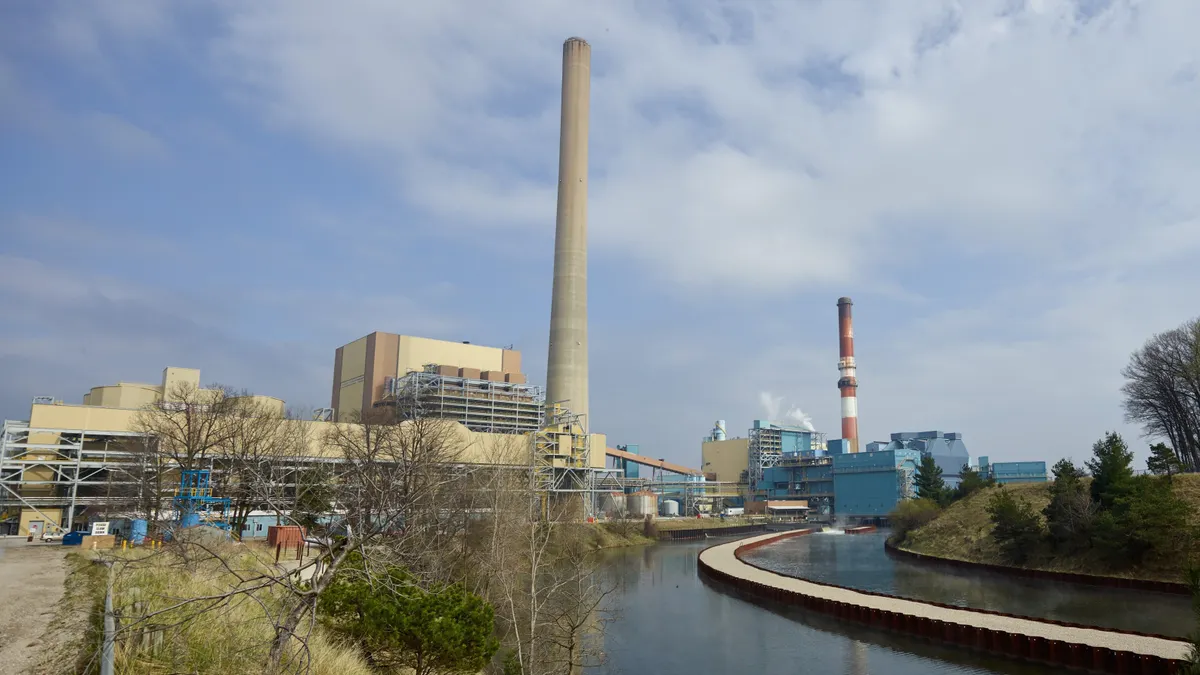
A federal appeals court on Friday vacated the U.S. Department of Energy’s emergency order requiring the owners of a coal-fired power plant in Michigan to delay its planned retirement, saying the move usurped state authority over generating resources.
“The federal government has, until now, issued stopgap generation orders in response only to transitory emergencies caused by war, extreme weather events, market manipulation, or unplanned, short-term unavailability of specific generation units,” the U.S. Appeals Court for the District of Columbia Circuit said in its ruling.
“It is the states — informed by federal, regional, and load-serving entities’ assessments of available supply and reliability needs — that bear the responsibility to plan for and avert reliability risks on an ongoing basis,” the court added, noting that the Michigan Public Service Commission and the Midcontinent Independent System Operator had approved the plant’s retirement after extensive reviews.
The suit was brought by Earthjustice, which represented the Sierra Club and Urban Core Collective. Also, the Michigan attorney general argued the case for Illinois, Michigan and Minnesota. Other petitioners included the Natural Resources Defense Council, Michigan Environmental Council, Environmental Defense Fund, Environmental Law and Policy Center, Vote Solar, the Ecology Center and the Union of Concerned Scientists.
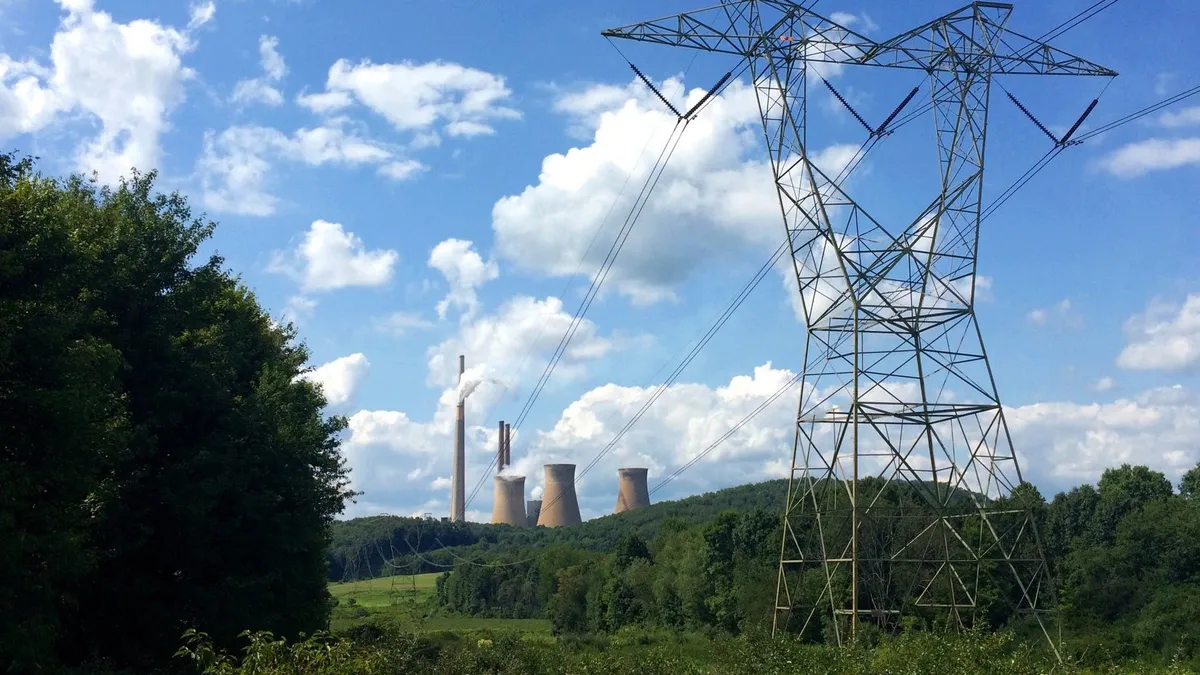
The court found that the DOE lacked the authority under the Federal Power Act’s section 202(c) to order Consumers Energy to run its majority-owned, 1,420-MW J.H. Campbell power plant past its May 31, 2025, retirement date.
Under section 202(c), an “emergency” means a grid reliability risk that calls for immediate action by DOE — a condition that wasn’t met in the case of the Campbell power plant, the court said.
The court said it was unpersuaded by DOE’s “sweeping conception” of its emergency authority under the FPA’s section 202(c).
“The Department’s position would empower it to pick its preferred power sources in Michigan — or, presumably, any other state — and order them to operate without regard to the multiple procedural and substantive constraints built into state reliability planning processes,” the court said.
Section 202(c) gives the DOE a “limited backstop mechanism” to address certain electricity supply emergencies, the court said.
“Contrary to DOE’s position, ... the complexity and advance planning that go into states’ assurances of resource adequacy do not imply that DOE must have vast, top-down emergency power to pick its favorite generators to run at all costs," the court said. "The Department’s reading of 'emergency' invites frequent federal interventions that are unsupported by the statute and threaten the stability of the energy market."
The DOE justified its order keeping the Campbell plant online by citing “fragments” of two documents and a MISO presentation it said showed that the region faced an emergency, the court noted.
The decision is among the first amid various legal challenges to DOE orders keeping fossil-fueled power plants from retiring to reach a court decision. Generally, the department has argued the plants needed to keep running due to the medium- to long-term potential for electric supply shortfalls.
Since the DOE issued its first 90-day order keeping the Campbell power plant from retiring, it has issued similar orders affecting six other power plants — all but one of which is coal-fired. DOE has reissued all the orders before they were set to expire.
Through June 30, the net cost of complying with the DOE emergency orders was $259 million, after applying MISO revenues of $239 million, Consumers said in a July 28 filing with the Securities and Exchange Commission.
“The court rebuked the Trump administration’s abuse of emergency powers,” Michael Lenoff, an Earthjustice attorney, said in a press release. “The DOE needs to stay in its lane and use its emergency powers only in actual emergencies. Preventing the market-driven retirements of coal plants to advance a coal-friendly agenda is not a proper use of emergency powers.”
The DOE could appeal the court’s ruling to the U.S. Supreme Court.
"The Energy Department's emergency orders, including at Campbell, prevented blackouts and likely saved hundreds of lives during peak capacity events this past year,” a DOE spokesperson said in an email.
The DOE’s emergency orders were “essential” for keeping the lights on during Winter Storm Fern in January, according to the spokesperson. At the peak of the bitter cold, coal-fired generation in affected regions increased 25% compared to the same time last year, and the Campbell plant operated at over 650 MW every day between Jan. 21 and Feb. 1, they said.
“The Department of Energy will continue to protect and defend energy security for all Americans," the spokesperson said.
Editor’s note: This story was updated with a comment from DOE.