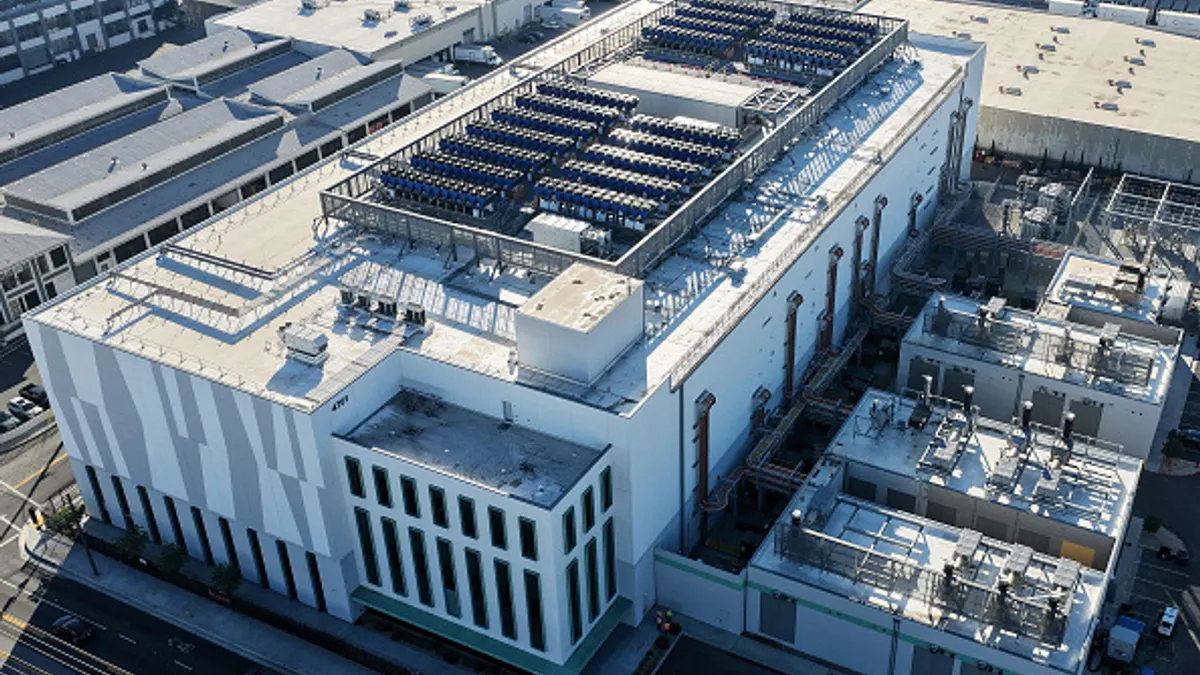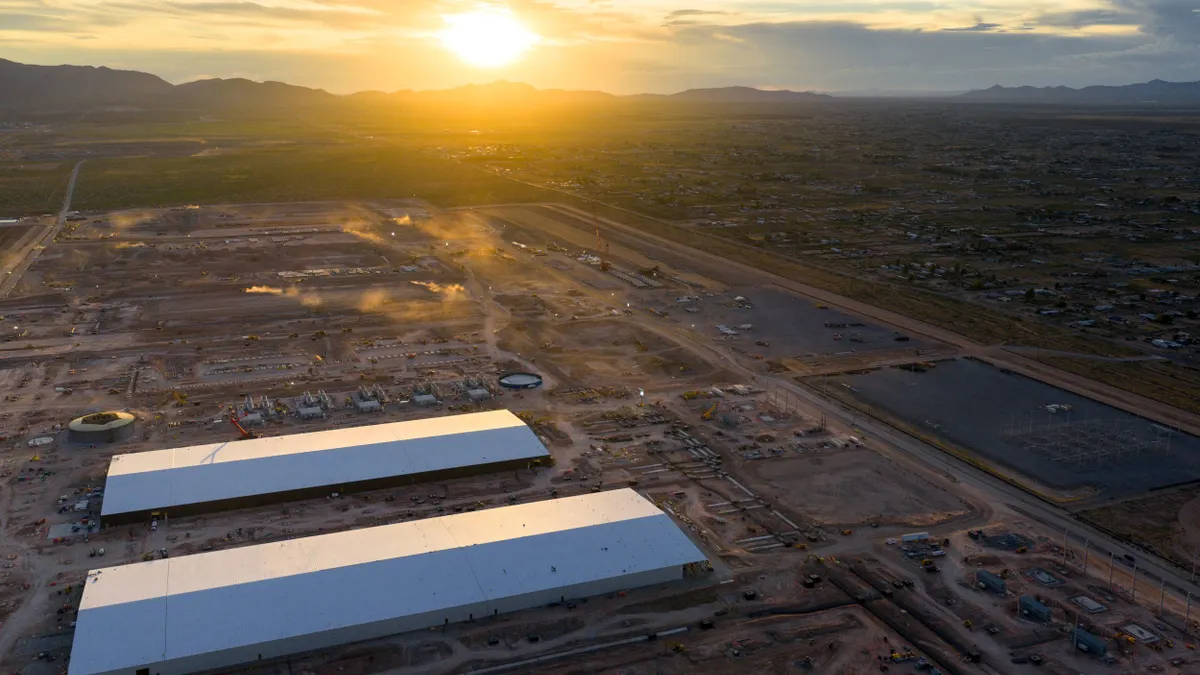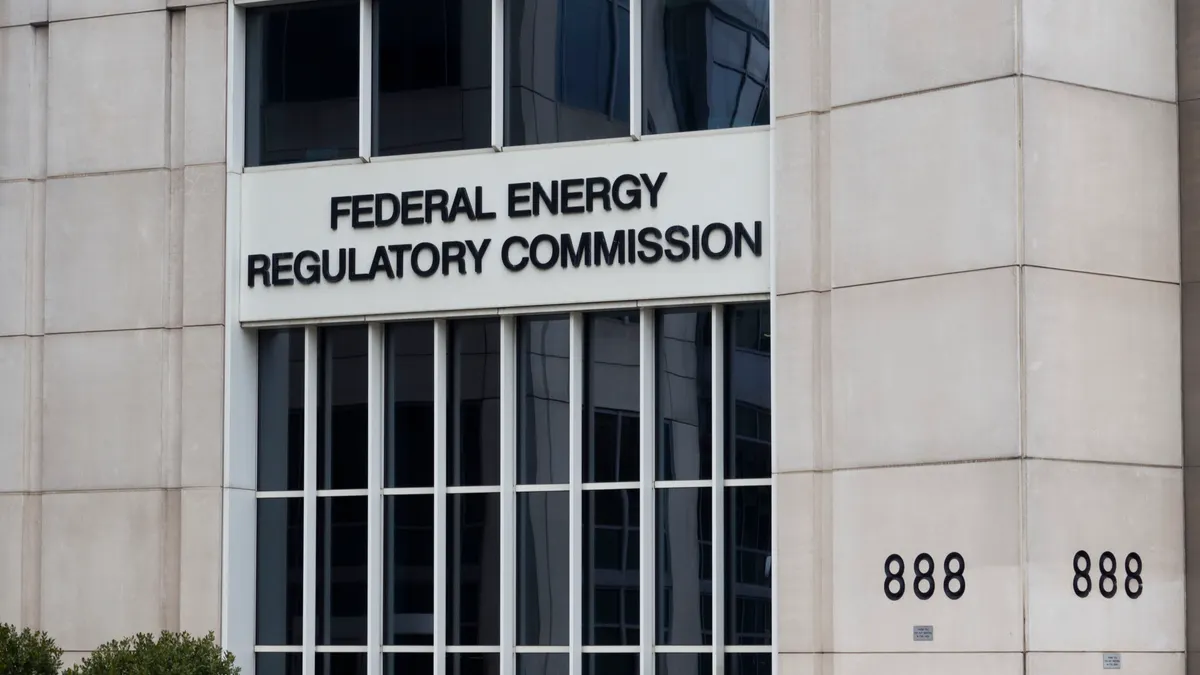
The Federal Energy Regulatory Commission plans to take action on the U.S. Department of Energy’s proposed reforms for interconnecting data centers and other large loads to the transmission system in June, the agency said Thursday.
FERC will address the problems discussed in the DOE’s proposal in “a manner that is quick, efficient, and legally durable,” the commission said in a notice of intent to act.
When DOE issued its proposed principles for interconnecting data centers in October, it asked FERC to make a decision by April 30. However, since then, the regulatory landscape around interconnecting large loads has changed, with FERC making decisions on proposals from the PJM Interconnection, Southwest Power Pool, Commonwealth Edison and Tri-State Generation and Transmission Association, the commission noted.
“But it is clear to us that further action is warranted to support further progress where it is needed,” FERC said.
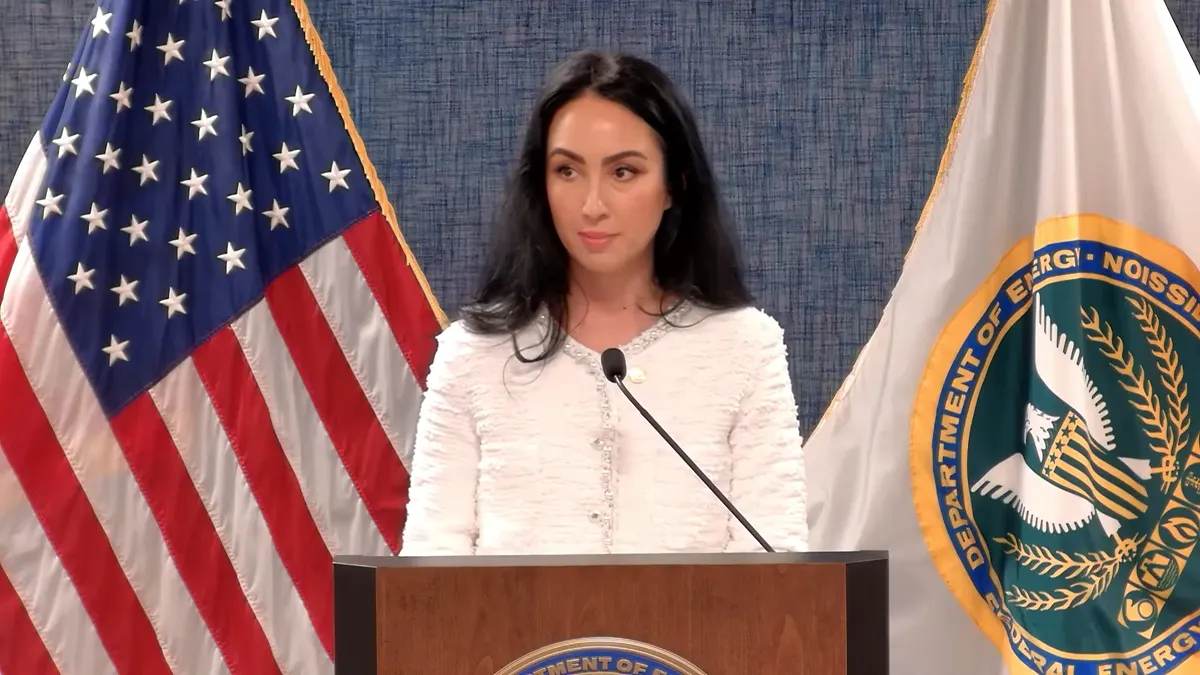
Ensuring federal-state jurisdictional boundaries are maintained is a key issue for the commission when developing a response to DOE, FERC Chairman Laura Swett said during a media briefing.
“I want to know exactly where the lines are of FERC jurisdiction versus state jurisdiction,” Swett said. “That is a very important issue that is a huge component of our action here. We do not take that lightly.”
In an April 13 filing at FERC, the National Association of Regulatory Commissioners highlighted recent efforts by states to develop data center interconnection rules.
“The abundance of recent state undertakings demonstrate that state commissions are in the best position to ensure rational and efficient interconnections of new large loads while protecting all customers … from improper cost-shifts or unfair interconnection processes,” the organization said.
FERC Commissioner Lindsay See said during the meeting that she is trying to make sure that the agency is “taking steps that are targeted to the right pressure points and in a way that doesn't slow up, but instead gives further momentum to that good work that is already happening in many markets and regions.”
In the meantime, utilities and regions are free to file proposals for new types of transmission or interconnection services, using some of the recently approved ones as models, Commissioner David Rosner said Thursday during the agency’s monthly meeting.
DOE supports FERC’s plan to respond to the department’s proposal in June. “I expect that the commission will act quickly and decisively to improve interconnection processes, support the co-location of load and generation, and accelerate the addition of new generation to ensure that supply is built alongside demand,” Deputy Secretary of Energy James Danly said in a statement.
Swett ‘perplexed’ by PJM backstop proposal
Swett said she is “a bit perplexed” by PJM’s initial proposal for a two-phase backstop procurement for about 15 GW. The proposal, which could change during a fast-track stakeholder process, calls for a six month period for power suppliers and large loads to negotiate bilateral contracts, followed by an auction in March during which PJM would procure any remaining needed capacity.
That extended timeline is different from holding a backstop auction in September as called for in a set of principles released by the White House and the governors in PJM’s 13-state footprint, Swett said.
In a letter released in January, the PJM board “acknowledged the importance of designing a backstop procurement to address the projected 60 GW shortfall in PJM, and the letter also directed PJM staff to quote, ‘accelerate and execute a backstop capacity procurement,’” Swett said.
“We are in a make it or break it year for the market,” Swett said. “We expect that the board and the stakeholders will do the right thing on this topic, and the various deadlines announced earlier this year.”
FERC Commissioner David LaCerte also pressed PJM for action.
“The situation is dire,” LaCerte said. “I wouldn't be surprised if there's serious conversation and talk about one or more major utilities or transmission companies — talk about maybe joining a different RTO … because I think it's reaching a boiling point here that we need action.”
FERC orders more changes to PJM’s interconnection study process
FERC on Thursday partly approved PJM’s latest proposed changes to its interconnection study process. However, the agency rejected proposed tariff provisions governing co-located generating facilities. It also directed PJM to adopt FERC’s definition for “system network upgrades” and to describe in its tariff how system network upgrade costs will be allocated among interconnection customers within a study cluster. FERC also ordered PJM to study the alternative transmission technologies in its Phase I System Impact Study and not wait until later, as proposed.
In a concurrence, FERC Commissioner Judy Chang urged PJM to clarify in its tariff its interconnection study procedures and network upgrade cost allocation practices. “Providing developers with a stable and predictable set of tariff-based rules will reduce the likelihood of disputes like those seen in RWE and Amelia, support more efficient administration of the queue, and ultimately promote a more durable and equitable interconnection process,” Chang said.
FERC rejects SunEnergy1 waiver request
FERC rejected a request by SunEnergy1 for a waiver from PJM’s rules for “readiness deposits,” financial security that must be posted during the grid operator’s interconnection process. The company entered two 126-MW projects in North Carolina into PJM’s interconnection queue in 2019 and 2020, and posted $44.1 million in readiness deposits. However, the projects became unviable when Congress scaled back federal tax breaks for renewable energy, which upset the company’s “settled expectation.”
FERC rejected the request, saying it would shift costs onto other project owners in PJM’s interconnection queue.
“Waivers are a limited regulatory tool intended to protect the public interest, not a pressure valve to alleviate discomfort with the commercial consequences of complying with a filed tariff,” Swett and See said in a joint concurrence. “Granting this waiver would undermine those foundational market dynamics by sending a signal that any project developer who encounters challenging economics may circumvent a Tariff’s financial consequences by seeking individualized relief.”
FERC closes ‘zombie’ dockets
FERC closed potential rulemakings that could have barred states from preventing aggregated demand response from participating in wholesale power markets and could have required stricter accounting for trade association expenses.
Rosner dissented from the demand response decision, saying demand response could help integrate large loads onto the grid. “We need every tool in the toolbox to meet the electricity demand growth our country is experiencing,” he said. “The commission should consider whether demand response provided by customers that individually consume hundreds of megawatts or more is best enabled through a patchwork of programs or by a single RTO/ISO-wide program.”
Issues related to trade association expenses and lobbying — and preventing ratepayers from paying for related activities — are best handled on a case-by-case basis, FERC said, noting that certain civic, political and other activities cannot be included in utility rates.