Dive Brief:
- About 160,000 customers in Florida and Alabama remained without power Monday morning, according to data from PowerOutage.us, after Hurricane Isaias made landfall Friday night as a Category 2 storm near Destin, Florida, along the Gulf Coast.
- Peak outages numbered approximately 950,000, according to the Edison Electric Institute, a trade group for investor-owned utilities. NextEra subsidiary Florida Power & Light was hit hardest, with 435,000 customer outages. It said it expected to restore power to 85% of those customers by the end of Monday — a downward revision of the company’s initial 95% recovery estimate in that time frame.
- Hurricane Isaias also impacted crude oil and natural gas production in the region, the U.S. Energy Information Administration said Friday. More than half of U.S. Gulf offshore oil and gas production was paused ahead of the storm, according to analysts, possibly leading to short-term price spikes.
Dive Insight:
Some parts of FPL’s system sustained more damage than the utility initially thought, leading it to revise its recovery estimates.
“As we continued our damage assessments in the hardest hit areas of the region, we discovered the tree damage to our system was much more severe and widespread than our initial estimates showed,” FPL President and CEO Scott Bores said in a statement.
The utility has also seen trees on lines and broken and leaning poles “that will require more extensive and complex work,” he added.
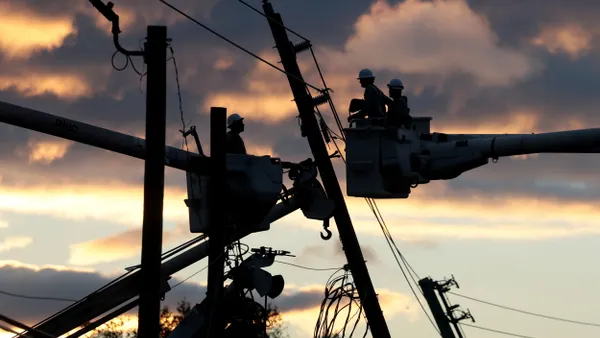
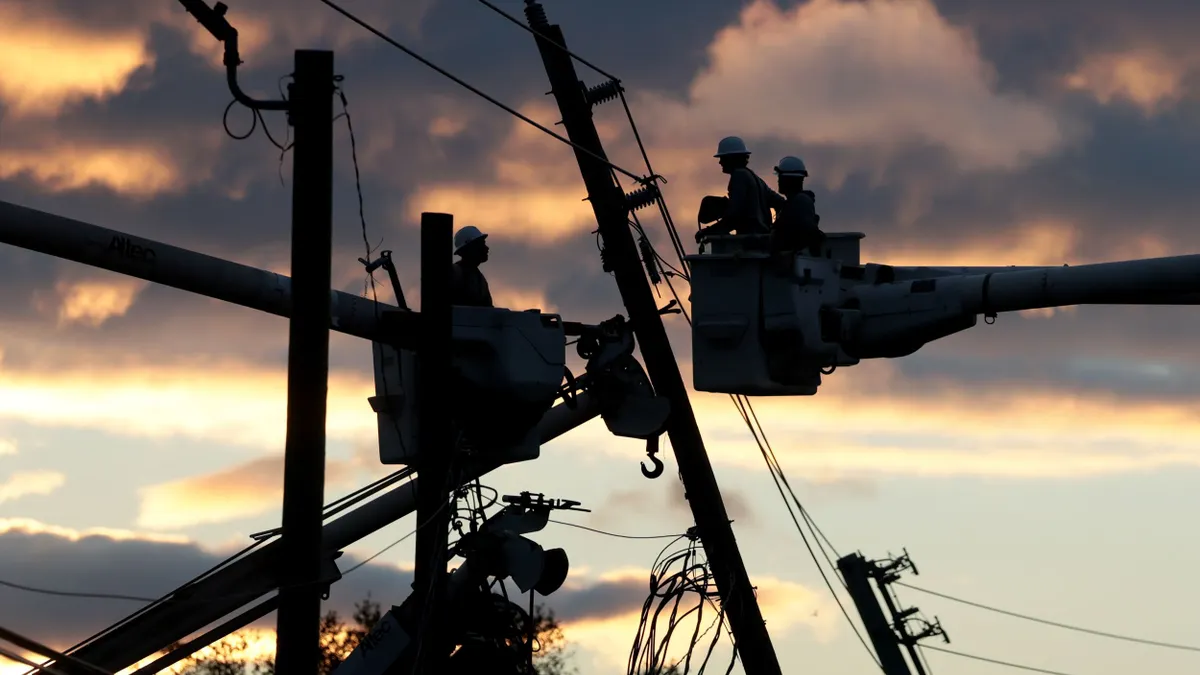
The hardest-hit portions of FPL’s territory include Escambia and Santa Rosa counties, on the western portion of Florida’s panhandle. The utility said it deployed almost 17,000 workers from across 29 states to help restore its system, and it is operating 15 staging and parking sites to position crews, equipment and resources.

Sunday night, FPL said it had restored power to more than 70% of customers impacted. It said its investments in grid resilience had aided restoration efforts, including smart grid technology “which avoided more than 130,000 outages.”
Underground power lines on FPL’s system “performed more than eight times better than overhead lines, according to initial forensics,” it said.
EEI President and CEO Drew Maloney also credited grid investments for helping utilities recover.
"Year-round planning, close coordination with federal, state, and local partners, and sustained investments in a stronger, smarter grid put thousands of workers in position to restore power quickly and safely,” Maloney said.
Duke Energy Florida on Saturday said it was “wrapping up power restoration” and that “strategic grid improvements delivered customer benefits.” The utility said it had restored power to approximately 10,000 customers, with 2,200 still offline.
“The strategic investments we’ve made in a stronger, smarter grid are delivering clear benefits for customers — reducing outages, limiting their duration and helping us restore power faster when severe weather strikes,” Todd Fountain, Duke Energy Florida storm director, said in a statement.
Alabama Power had restored service to 90% of customers on Sunday, according to local media reports. AL.com reported that more than 390,000 customers experienced outages in the state.
The storm made landfall near the Florida-Alabama border, disrupting some energy-producing areas of the Gulf Coast.
According to analysts at AccuWeather, nearly 63% of offshore oil production and 57% of natural gas production in the Gulf were paused ahead of the storm’s landfall, with almost one-third of Gulf production platforms evacuated.
“The widespread shutdown of oil and natural gas production shows how a major hurricane can have far-reaching economic consequences beyond near where the storm makes landfall,” AccuWeather Vice President of Forecasting Operations Dan DePodwin said in an emailed statement.
“There might be some short-term increase in gas prices due to the temporary production shut-in. However, since Isaias’ worst impacts are expected east of the major production and refining locations, a long-term supply issue is not currently expected,” DePodwin said.
Editor’s note: This story was updated to indicate roughly 160,000 customers in Florida and Alabama remained without power Monday at 1 p.m. ET.