Dive Brief:
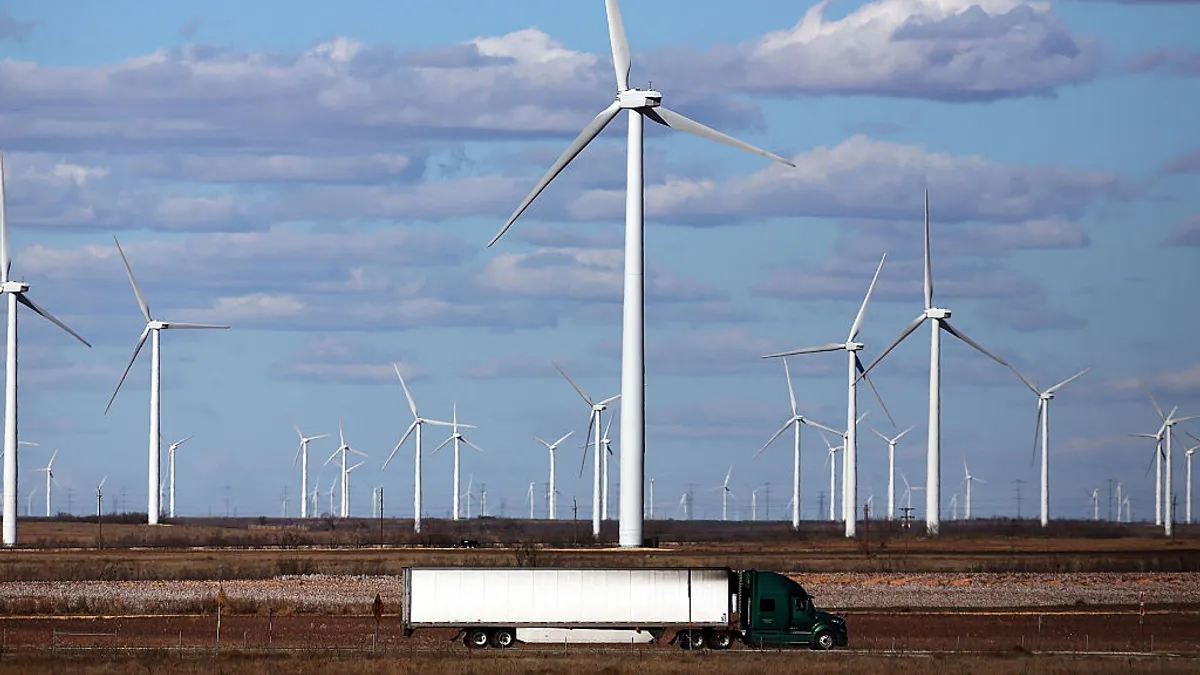
- The United States added nearly 5 GW of land-based wind capacity in the second quarter of 2026, but the pipeline for such projects fell 4% amid regulatory and price pressures, according to the American Clean Power Association’s most recent market report.
- John Hensley, senior vice president of markets and policy analysis at ACP, told Utility Dive in an interview that his organization has calculated at least 44 GW of wind projects are “stuck” in review at the U.S. Department of Defense. A judge recently ordered the department to restart those reviews after an apparent pause.
- “Time will tell how the Department of Defense reacts to that judgment, and whether or not they start to process those wind projects in the same way that we saw them do before a lot of these actions were implemented,” Hensley said. “If that is the case, then I think there is a large volume of projects sitting behind that bottleneck.”
Dive Insight:
Despite federal policy changes that have been unfavorable to renewables, the report found that the pipeline for clean power — defined as land-based wind, offshore wind, utility-scale solar and battery storage — has surpassed the 200 GW mark and was up 11% year over year in the first half of 2026.
Hensley said new offtake announcements for clean energy “are up 23% year over year and 10% quarter over quarter,” and tied this to the recent increase in power demand associated with data center load growth.
“We see companies like Google transacting for a large volume of projects,” he said. “Google alone was 54% of corporate PPA announcements in Q2, but we also saw Meta, Oracle, and others coming along in that game as well.”
While hyperscalers accounted for many large purchase agreements, utilities were the largest purchaser type to procure clean projects so far in 2026, the report said.
Utilities contracted 15,048 MW of capacity, mainly through PPAs, accounting for 71% of offtake agreements, it said. The commercial and industrial sector was the second largest group of clean power procurers with 3,590 MW.
When it comes to wind power, specifically, a lot of demand is “continuing to come down the pike,” Hensley said. “And as that volume of viable wind projects decreases over time, obviously they can command a premium in the marketplace, especially when everybody is pretty desperate for power on a quick timeline.”
Average national PPA prices in Q2 2026 were $83.79/MWh for land-based wind and $61.40/MWh for solar, the report said, citing data from LevelTen Energy.
Land-based wind PPA prices increased 5.5% quarter-over-quarter and 17.5% year-over-year, while solar prices declined 4.8% from Q1 2026 but remained 6.7% higher than a year earlier, the report found. The price gap between land-based wind and solar has grown to $22.39/MWh — “a 36% difference, the largest recorded,” it said.
Hensley said there are good signs for the wind industry, including the August issuance of a preliminary injunction against DoD’s review freeze by Judge Karin Immergut with the U.S. District Court for the District of Oregon.
However, Hensley said he anticipates that the gap between solar and wind PPA prices will start to close within the next few months, as he believes solar prices will soon rise in connection with an Aug. 6 executive order which set a 15% rate of duty on imports of polysilicon derivatives.
While markets like California and Texas are “working well” to connect clean power to the grid, “there’s a lot of ground to cover” nationally in terms of transmission bottlenecks and congested interconnection queues, he said.
“PJM remains a major bottleneck,” he added.
In Texas, ACP’s report noted that battery storage projects “have significantly lower storage durations compared to other states due to the structure of the ERCOT power market, with an average duration for online projects of 1.6 hours.” Texas currently has the largest storage fleet in the U.S., with 17,404 MW/28,326 MWh, the report said.
Hensley said he anticipates a convergence of storage duration across markets in the coming years.
“Texas's particular market design has encouraged a lot of two-hour batteries that come in and provide a lot of ancillary services and take advantage of price arbitrage in that market,” he said.
He added that as a lot of that opportunity is “competed away,” along with increasing demand to “carry solar deep into the evening or bring overnight wind into those early morning hours,” the Texas market will see more demand for longer-duration batteries.
“We’re seeing that everywhere,” Hensley said, citing Google and Xcel Energy’s work to deploy a 100-hour storage project with batteries built by Form Energy. “Utilities and grid operators are really starting to explore these longer-duration battery options … Price certainly helps. It may be as the cost of that technology comes down, those longer-duration storage options become much more viable.”