Dive Brief:
- Two U.S. automakers took steps this month to expand their electric vehicles’ value to the power grid and electric utility efforts to manage peak demand.
- On Tuesday, Rivian became the latest automotive company to partner with ChargeScape, a vehicle-grid integration platform that supports utility managed and bidirectional charging programs across the country. Earlier this month, General Motors said it would release a firmware update that gives existing GM Energy vehicle-to-home systems full vehicle-to-grid capability with no hardware modification needed. It also announced a V2G partnership with DTE Energy, a Michigan investor-owned utility, and additional plans with Pacific Gas & Electric.
- With more than 7 million EVs on U.S. roads and expectations for significant fleet growth over the next four years, utilities increasingly see managed and bidirectional charging as important load management levers.
Dive Insight:
Launched in 2023, the ChargeScape platform is backed by BMW, Ford, Honda and Nissan and used by Tesla, Stellantis and other automakers. The platform enables a range of utility-led charging frameworks, including passive managed, active managed and bidirectional charging. Passive managed charging programs typically use time-of-use pricing to encourage drivers to charge their vehicles at off-peak times, when grid congestion ebbs, while active managed charging programs adjust energy flows to plugged-in vehicles as grid conditions change.
Bidirectional charging, which is only possible with certain vehicles and compatible charging equipment, allows energy to flow from vehicle batteries into homes or the grid itself. ChargeScape and Puget Sound Energy are running a small pilot in Washington state to test how Ford and Kia vehicles perform as demand response assets during periods of peak demand. Vellone said the pilot builds on an existing one-direction demand response partnership.
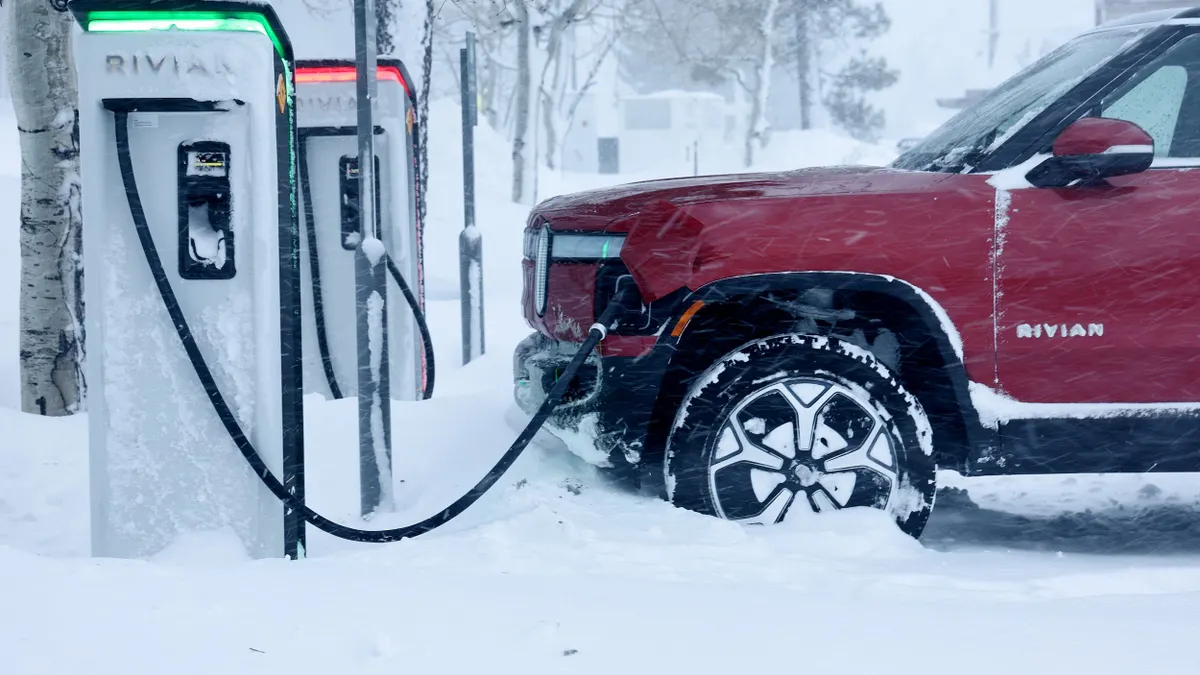
Rivian, which only sells all-electric vehicles, is at least the seventh automaker to join the ChargeScape platform, ChargeScape CEO Joseph Vellone told Utility Dive. Rivian drivers can now opt into bidirectional charging programs their utilities offer, the companies said.
“The more automakers we have on the platform, the more the industry benefits,” Vellone said. ChargeScape currently supports about 70% of light-duty EVs on the road, and “we want to get that to 100%,” he added.
With Rivian joining the platform and the pilot with Puget Sound Energy, “Rivian drivers in Washington state will be able to save a few hundred dollars a year simply by plugging in at home,” Vellone said.
Washington is a good example of a state market where relatively high EV penetration has utilities weighing the risk unmanaged charging could pose to distribution-grid assets such as transformers against the potential for private EV fleets to serve as “a meaningfully-sized flexible load resource” that can help reduce system costs borne by all ratepayers, Vellone said.
That’s an enticing prospect for utilities like PG&E, whose populous California territory is further ahead than most on the EV adoption curve. GM laid out a “2030 vision” to have 130,000 of its vehicles on the road in Northern California by 2030 and for about 40% of them to participate in “grid-balancing protocols,” the automaker said last week.
With DTE, GM plans to use its own employees’ homes to refine GM vehicles’ bidirectional charging capabilities and “grow reliable backup capacity together in a way that’s built to the preferences of real home and EV owners,” Wade Sheffer, vice president of GM Energy, said in a June 9 open letter.
Sheffer urged utility leaders, regulators and automakers to work together to educate customers on the benefits of EV grid support and enabling programs, to develop and expand local time-of-use tariffs that reduce vehicle operating costs while mitigating grid stress and to streamline bidirectional charging bottlenecks such as engineering reviews and utility interconnection processes.
“Simplifying these processes into a more frictionless, automated step ensures that a consumer can buy a bidirectional charger, plug it in, and immediately begin participating in the local energy marketplace,” Sheffer said.