Meeker Energy, a member-owned electric cooperative serving about 10,000 homes and businesses in central Minnesota, is typical of many non-profit utilities across the country. While investor-owned giants tout the profit potential of large-load pipelines in the gigawatts, distribution coops like Meeker are watching the wholesale cost of electricity rise, with little they can do to mitigate it except controlling for their own consumption. That expense accounts for the largest part of members’ bills.
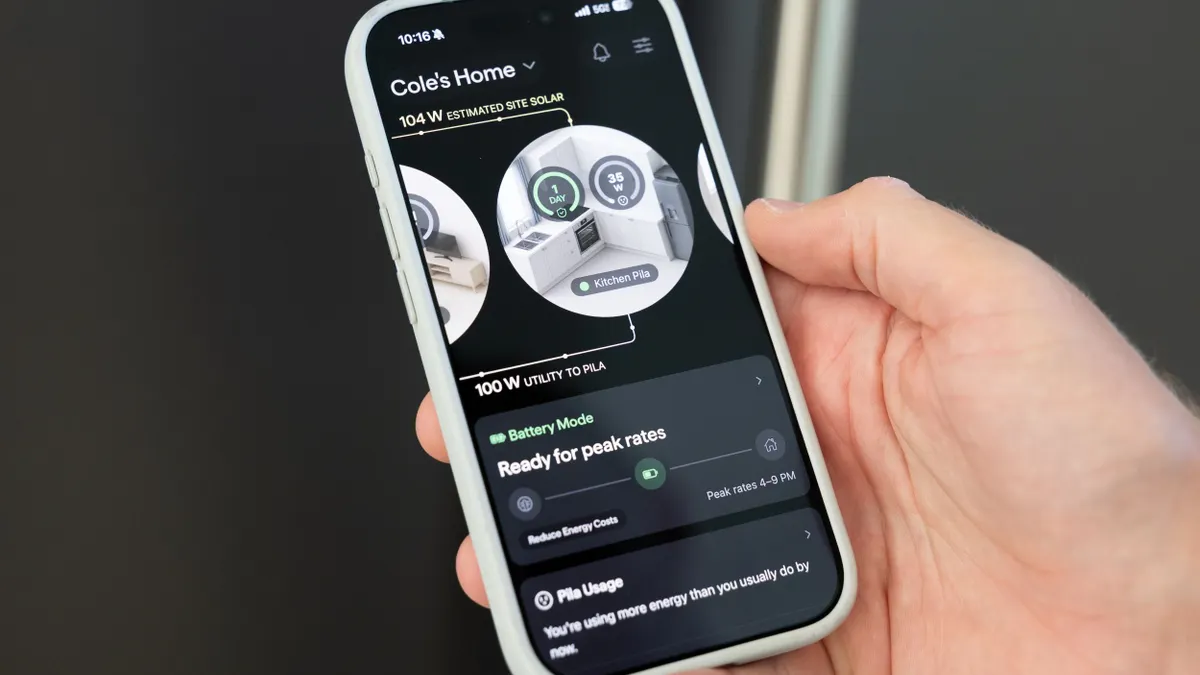
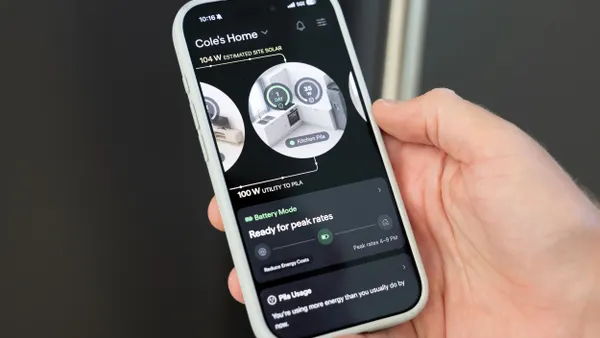
That’s where storage comes in. The utility is in the early stages of testing behind-the-meter residential batteries at members’ homes for resilience and demand response.
Steve Kosbab, Meeker’s energy services manager, said 60% of its members participate in at least one of its load management programs, which already helps Meeker reduce wholesale power demand charges.
“We’re at a level of demand response where we can only shed so much … so we’re looking at how we can enhance demand response programs that are very mature and very successful,” Kosbab told Utility Dive.
Kosbab said Meeker considered incentives for its rural and exurban customer base to add standby generators that run on propane or natural gas, but “a person could get upside down on the fuel costs versus the electric savings” with such equipment. Partial- and whole-home batteries seemed to make more economic sense, he said.
Storage is on the rise across the power sector and on both sides of the meter. As the technology evolves, prices have fallen and capacity has gone up. At the same time, generator retirements and rising demand have caused the grid’s reliability watchdog to warn of potential electricity shortfalls, leading everyone – from residents to hyperscalers to utilities – to invest in storage as a backup in case of a blackout or curtailment, as well as a hedge against price spikes.
Last summer, rural electric cooperatives had 439 MW/1,047 MWh of operating battery energy storage projects, according to the National Rural Electric Cooperative Association.
Those numbers do not necessarily include every behind-the-meter battery in cooperatives’ service territories. They also represent a tiny fraction of the 28 GW/57 GWh of energy storage that Benchmark Mineral Intelligence says connected to the U.S. grid in 2025.
But a lot more could come online soon: NRECA is tracking dozens of smaller-scale projects in development that it says could more than triple rural cooperatives’ energy storage capacity by 2028.
Many of the projects pursued by non-profit utilities will connect to the distribution networks they manage. And a significant amount of the planned capacity will be behind individual members’ electric meters.
Guadalupe Valley Electric Cooperative, which serves a rural-to-suburban region east of San Antonio, said last month it would expand a pilot with Base Power that installs heavily discounted residential batteries. It expects the program to grow from 2 MW to 50 MW over the next few years.
In the Electric Reliability Council of Texas territory, the distributed approach is more cost-effective than deploying grid-scale storage, general manager Darren Schauer told Utility Dive.
NRECA says initiatives like these will help shave costly demand peaks, firm intermittent generation, boost resilience and defer infrastructure upgrades. Some energy storage projects will hook up to transmission grids managed by regional cooperatives.
Beth Soholt, executive director of the Clean Grid Alliance, which focuses on the Midcontinent Independent System Operator region where Meeker is located, said cooperatives are eager to adopt new technologies when it’s in their members’ interest, and may not need the “carrots and sticks” state policymakers and regulators use to push investor-owned utilities to innovate.
“Cooperatives really can be innovative,” Soholt told Utility Dive in an interview. “I’ve been impressed over the years how they’re able to pick up on new things and just do them.”
Peak shaving and profit models
In addition to deploying batteries with colocated renewables and encouraging members to use their own energy storage, some cooperatives are also leaning into storage on the distribution system for reliability and economic reasons.
Earlier this year, Blue Ridge Power Agency, a Virginia power wholesaler for municipal and cooperative electric utilities, announced plans to deploy about 25 MW of distribution-connected energy storage at five sites owned by three member utilities. The batteries will charge during periods of low demand and discharge during periods of high demand, providing a source of peak power capacity amid sharply rising load growth in Virginia and the broader PJM Interconnection, BRPA said.
The Electric Power Board of Chattanooga, Tennessee, has 45 MW/95 MWh of front-of-the-meter energy storage in service now and plans to double that capacity over the next 12 months, Ryan Keel, its president of energy and communications, told Utility Dive earlier this year.
One of the new deployments will be a four-hour system anchoring a microgrid in a mountainous area outside central Chattanooga that has a tenuous connection to the main grid and is prone to outages.
But the utility uses most of its existing and planned battery capacity to shave demand peaks. It buys wholesale power from the Tennessee Valley Authority, whose monthly demand charges can account for one-third of EPB’s total power purchase costs, Keel said.
TVA bases each month’s charge on the hour of highest demand, “so whenever that hour occurs, we have a financial incentive to reduce that peak with energy storage and other measures,” Keel said.
That incentive is especially pressing for not-for-profit utilities that — unlike investor-owned utilities — do not earn a regulated rate of return on capital investments, many cooperative and municipal utility leaders say.
The debate over how that profit model influences storage programs was on full display in Minnesota, where regulators recently approved investor-owned Xcel Energy’s Capacity*Connect pilot, a novel type of virtual power plant that will see up to 200 MW of utility-owned distribution-connected storage deployed by 2028.
Representatives from a coalition of nonprofits opposed the utility-owned framework, as opposed to one allowing third parties to aggregate customer-owned resources. They claimed Capacity*Connect would shift financial risk to captive ratepayers and deliver significantly less value than a superficially similar virtual power plant Xcel plans to deploy in Colorado with participation from customer-owned assets.
Xcel spokesperson Kevin Coss told Utility Dive that cost-benefit analysis “is one tool out of many” that the company uses to evaluate potential programs — one that is “inherently limited because it does not consider qualitative benefits or as-yet-unknown potential value,” he added.
Coss said Xcel “expects to measure and evaluate the ongoing costs and benefits of the program” and report them in both quarterly filings and “interim program assessment” to be released by August 2028.
Xcel has said Capacity*Connect will complement its growing renewable generation portfolio and preserve dispatchable capacity as it retires thermal assets in Minnesota. Even if its approach to distributed energy storage differs from some cooperatives’, Soholt said the program and hundreds of megawatts of more traditional utility-scale projects in MISO’s northern zones will produce valuable lessons for the region’s not-for-profit utilities.
Reliability, fuel savings drive nonprofit utilities’ BESS adoption
Energy storage is particularly appealing for non-profit utilities serving communities in remote or isolated communities with limited transmission.
In rural Alaska, Homer Electric Association installed a 46.5 MW/93 MWh BESS in 2022 to boost reliability in a remote coastal area served by a single 115-kV transmission line. An outage on that line can cost the association upwards of $20,000 per day in added fuel costs, HEA executives said at the time. In 2024, HEA got a $100 million U.S. Department of Agriculture loan to add another 45 MW/180 MWh BESS nearby.
Several hundred miles north, near Fairbanks, the Golden Valley Electric Association will use its own $100 million USDA loan for two cold-hardened 46 MW/92 MWh BESS units that it says will boost reliability, reduce fuel costs and provide spinning reserve service.
In March, the Hawai’i Public Utilities Commission approved a 43 MW/172 MWh solar-plus-storage project that will cover nearly 20% of Kaua‘i Island Utility Cooperative’s load. KIUC says the project will significantly reduce its fuel costs, saving the cooperative and its members an estimated $365 million over 25 years — up to $21 per month for the average residential customer.
In North Carolina, Tideland EMC operates a nearly 10-year-old microgrid that pairs a 3-MW diesel generator with a 1-MWh battery and a small solar array to back up storm-prone Ocracoke Island’s mainland grid connection.
And Nevada’s Valley Electric Association plans to add two BESS arrays to its sparsely populated territory northwest of Las Vegas: a 35-MW bulk installation that will help mitigate power costs and integrate renewable energy, and a 2-MW solar-plus-storage facility in a remote valley community whose sole grid connection is vulnerable to wildfire-related public safety power shutoffs.
Energy storage also offers clear value for not-for-profit utilities in more populous areas with robust transmission connections, including for the entities that own the transmission assets themselves.
For example, the Tennessee Valley Authority, the country’s largest public power entity, aims to add 1.5 GW of energy storage capacity by 2029, starting with a 200 MW/800 MWh deployment in Alabama.
Larger distribution cooperatives also see the value in bigger energy storage installations that provide critical capacity and help avoid potentially costly system upgrades.
Connexus Energy, which has about 150,000 members across east-central Minnesota, built the state’s first megawatt-scale grid batteries in 2018. Those early systems, totaling 15 MW/30 MWh of storage capacity, initially charged off colocated solar but now draw from the grid as well, Tessa Haagenson, Connexus vice president of power supply, told Utility Dive.
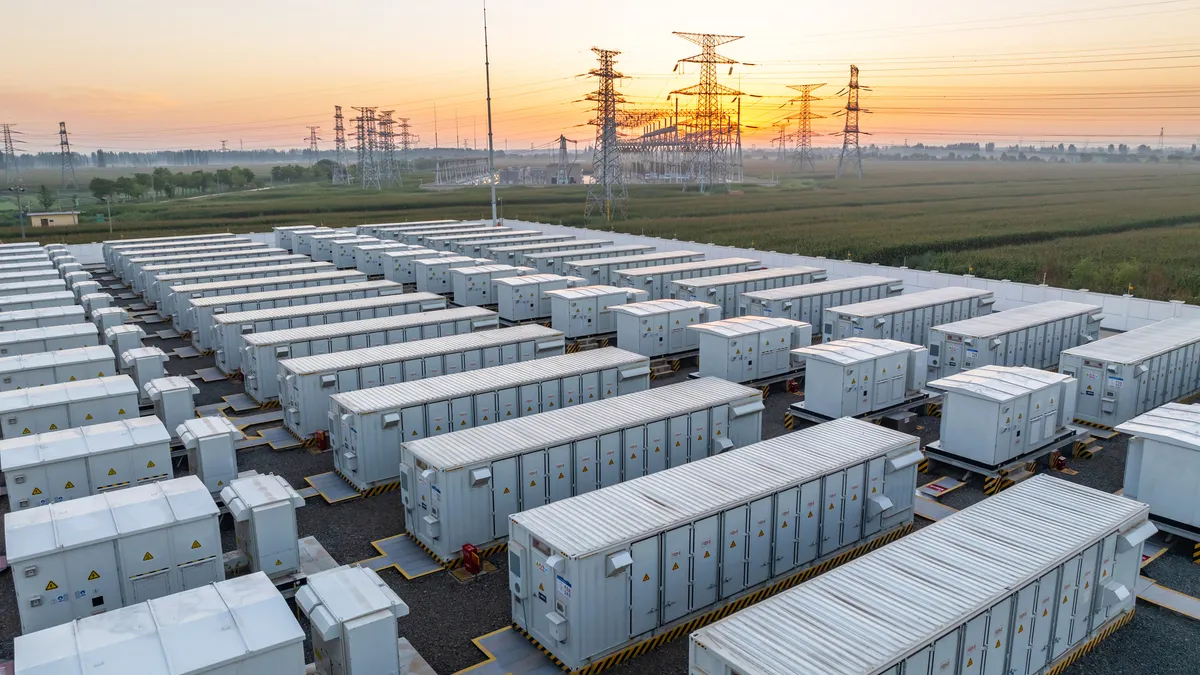
So does a 2.5 MW/10 MWh standalone battery installed in 2025 at a substation in a congested part of Connexus’s grid. The system boosts reliability in the area without requiring a larger transformer, saving members money and avoiding a disruptive upgrade process, Connexus says.
And because it’s registered with MISO as a capacity asset, the battery system “can capture additional wholesale market value streams through accredited capacity and strategic dispatch during high price periods,” Haagenson said.