Sunrun, the United States’ biggest installer of residential solar and energy storage systems, added 25% fewer subscribers in the first quarter of 2026 compared with the first quarter of 2025. Solar and battery capacity additions fell 19% and 15%, respectively, over the same period, the company said Wednesday.
The first-quarter drop in sales was caused by a slump in lead generation and sales activity in mid-2025 driven by uncertainty around the final shape of Republicans’ One Big Beautiful Bill Act, along with Sunrun’s decision to reduce its exposure to third-party installers, Sunrun Chief Financial Officer Danny Abajian said Wednesday during an earnings call with investors and stock analysts.
But Sunrun’s sales activity in early 2026 suggested “an inflection point toward growth,” Abajian said.
President Donald Trump signed the OBBBA in July. The final version terminated a key federal tax credit for customer-owned home energy systems at the end of 2025, prompting a short-lived rush to install qualifying systems before then.
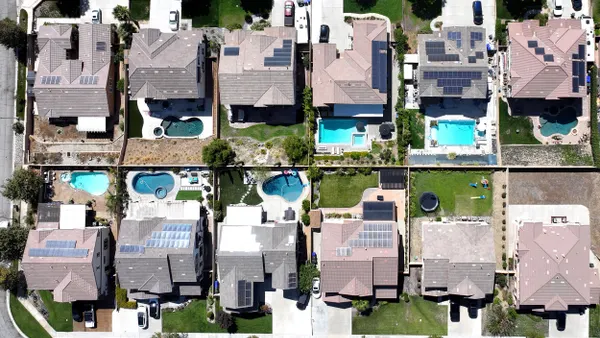
Although the 25D expiration caused “significant volume declines” for smaller solar dealers and some Sunrun affiliate partners, Sunrun was better positioned for the change because almost all of its sales volume comes from subscriptions, where Sunrun retains ownership of the distributed resources it installs and sells the energy to customers, Sunrun CEO Mary Powell said.
Installations of such “third-party owned” systems continue to qualify for federal tax credits under the OBBBA.
“We are not seeing similar impacts from changes to the 25D tax credit,” Powell said.
Despite the headline declines in subscriber and capacity additions, investors took Sunrun’s latest earnings report well. As of Friday morning, the stock was up more than 10% since Wednesday’s earnings announcement.
Ongoing headwinds from tariff and tax policy
In regulatory filings and materials released to investors Wednesday, Sunrun noted ongoing headwinds for its business and distributed solar-and-storage generally.
The company’s latest quarterly filing warned that solar panel prices could increase and product availability could decline in the future “due to a variety of factors, including supply chain disruptions, inflation, tariffs and trade barriers, export regulations, geopolitical conflicts, regulatory or contractual limitations, industry market requirements, and changes in technology and industry standards.”
Sunrun said tariffs targeting certain producers of solar cells and modules in Vietnam, Malaysia, Thailand and Cambodia “generally has [had] an inflationary effect on module prices.” So have 50% tariffs on imported steel and aluminum and Section 232 duties on a range of clean energy products and inputs, Sunrun said.
And though the U.S. Supreme Court invalidated President Trump’s broadest import duties in late February, Sunrun said “significant uncertainty remains regarding the legality and effect” of the tariffs Trump has said he would impose in response.
Powell said Sunrun was well-positioned to tackle at least one broad headwind for the industry: the “regulatory complexity” of complying the domestic content and “foreign entity of concern” rules authorized by the OBBBA.
“We believe that our experience and scale give us tremendous advantages to navigate these items, from equipment procurement, logistics and compliance,” she said.
Continued growth in dispatchable capacity
Sunrun says it remains “the nation’s largest distributed power plant operator,” with more than 251,000 solar and storage systems installed and about 4.3 GWh of networked storage capacity as of March 31 — a 50% increase year over year. It expects to have 10 GWh of dispatchable capacity online by the end of 2028, it said.
“That is not just a metric — it is infrastructure … and it is something no one else in this industry has at our scale,” Powell said.
Powell said Sunrun’s growing distributed storage network would provide customers with “price certainty and backup power” as rising power demand strains the grid and utility rates march upward. Its recent shift away from third-party installers and toward “our direct business” — which has seen its salesforce grow 20% year-to-date — would help it design and manage energy storage systems more effectively, she added.
Average U.S. electricity prices have recently risen faster than the broader inflation rate. They rose 9% year over year in February, according to the U.S. Energy Information Administration.