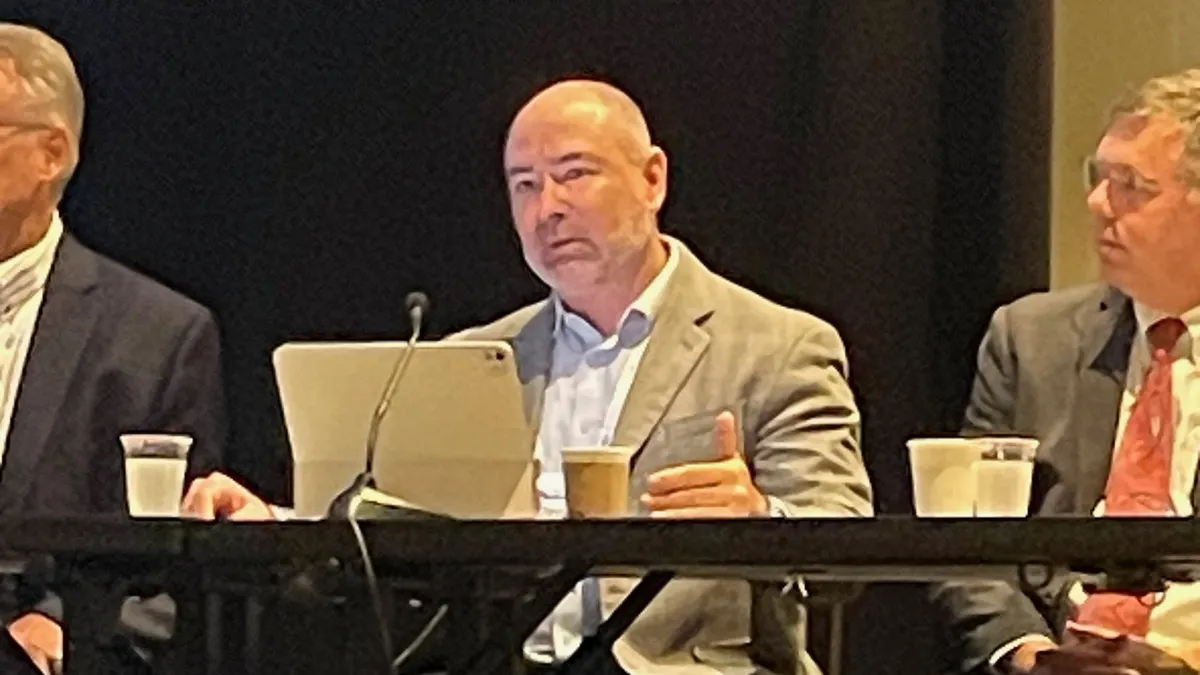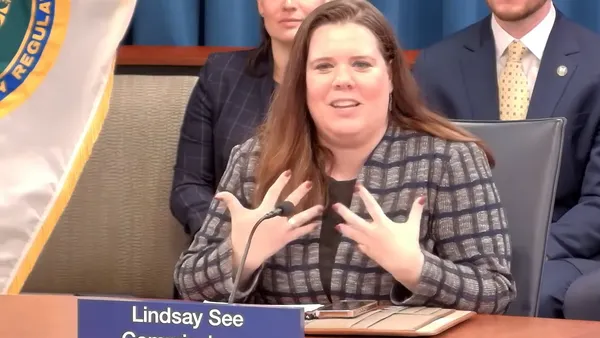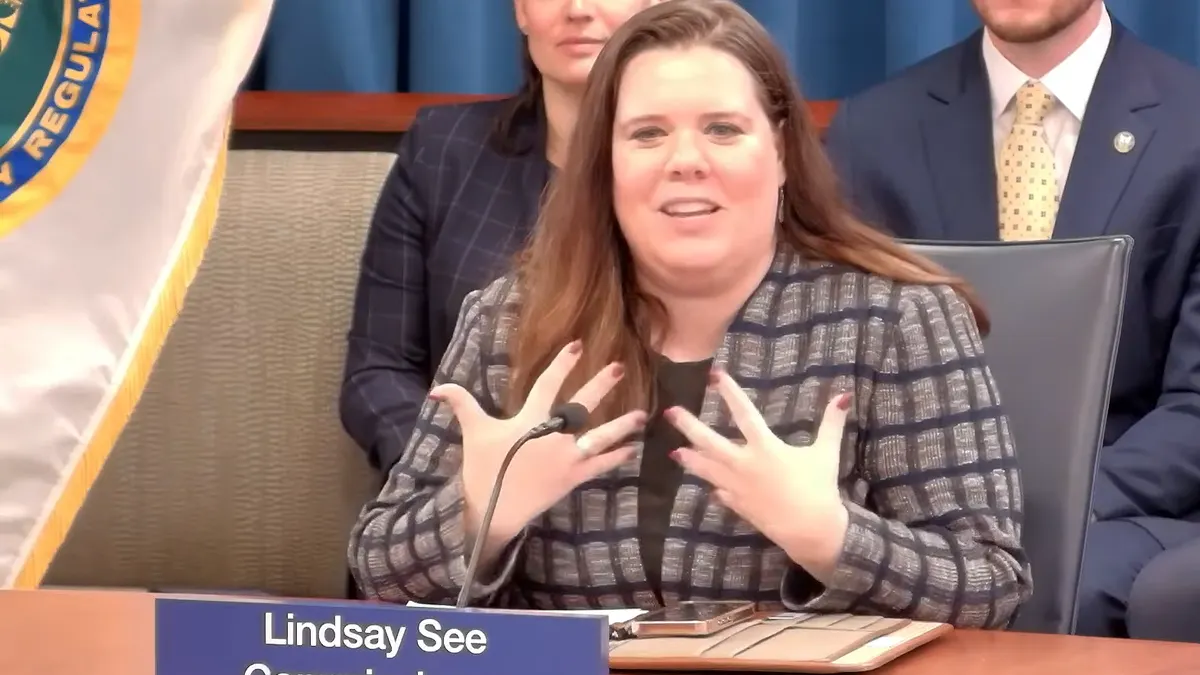
Lindsay See, a member of the Federal Energy Regulatory Commission since mid-2024, has been a leader on the agency’s permitting reform initiatives and has joined other commissioners in pushing transmission owners to use grid-enhancing technologies. Utility Dive met with See on Wednesday at the National Association of Regulatory Utility Commissioners’ annual meeting in San Juan, Puerto Rico.
Before joining FERC, See served as West Virginia’s solicitor general, where she successfully argued a case at the U.S. Supreme Court challenging greenhouse gas rules for power plants.
This interview has been edited for length and clarity.
UTILITY DIVE: We're at NARUC, so I'm curious what you're saying to the states, what you want them to hear.
LINDSAY SEE: I find NARUC really valuable because I am a former state attorney myself. I worked for the West Virginia [attorney general’s] office. I firmly believe in the importance of state and local solutions, and I think that's what I want to say to the states.
But primarily, it's what I want to hear from the states because I think we have so many issues where we have jurisdiction at FERC, and the states do, [too,] and I want to make sure that we're pulling in the same direction. So that's a lot of my message: How do we keep lines of communication open so they have the information they need from us, and vice versa.
I want to learn the different ways that states are approaching affordability issues, large-load challenge issues, how we can help at FERC. Some of what we're looking at is, how do we make sure that a lot of these new regulatory pushes and policies we have don't have unintended consequences.
And then, what are you hearing from the states?
They want more transparency, especially when it's coming to affordability issues. How do we make sure that they have the same information that we have so that they can do their job better when it comes to allocating retail rates? Particularly when it comes to large-load integration, there's been some blind spots on the state side in terms of which customers on the transmission side are driving those costs.
How are you thinking about transparency?
Even just a few years ago, when I worked in West Virginia, we didn't talk about PJM that much. Now we have regular ratepayers who are not energy nerds who are reading about PJM on the front page of the news and are seeing their bills go higher. So I think we're seeing a lot more pressure on what we're doing to understand, what do we have responsibility over, what don't we? That kind of public conversation is really different, but really helpful because it puts a really important focus for us to make sure that we have a clear sense of what we can control and what we can't control.
What can you control at FERC?
We've got a few buckets that we're really focused on. One is — especially when it comes to large-load integration and the show cause orders we have — how do we have transmission cost agreements that are clear about which customers are driving those costs to make sure that they're the ones who are paying their share and we're not saddling existing customers with those costs or with the risk of stranded investment.
In order to meet this incredible opportunity we have from large-load growth as a country, it's going to take new transmission investment that's absolutely required and it's necessarily expensive. So I think it's even more important for us to make sure that we are making the right sort of investments into the system.
In those show-cause orders, we focused on requiring transmission owners to consider alternative transmission technologies — to say, how can we do more with the existing system. I'm really focused on pushing as far as we can within our statutory structure because I understand we need new wires. But I want to make sure we've got the right incentives in place to use what we already have really well.
We need more infrastructure, both on the transmission side and on the pipeline side, so how do we make that permitting process as efficient and streamlined as possible? Because reducing that time and the legal uncertainty also has a direct cost consequence in terms of the amount of money those projects ultimately cost. So that is something within our control in areas where we've got permitting authority.
On permitting, you've been driving an effort to have expanded blanket certification for natural gas projects. Could this affect the power sector?
We see so much of the electricity sector that's powered by natural gas, being able to get that fuel where it needs to be at the right time is critical in order to have a reliable and affordable electricity sector, too. So the way I look at it is, everything that we can do to encourage a more efficient, streamlined, legally durable permitting process on the gas side has direct consequences on the power side, too.
Some organizations and people are very concerned that FERC could be weakening environmental reviews. What are you saying to those groups?
I hear those concerns. I take them seriously. I, probably unsurprisingly, disagree with them. We do have really important environmental responsibilities, [and] I think it matters for us to fulfill those, but also not to go further than what the statutes require. And so I think some of the work that we've been doing over the past year and just in the past month, announcing a new draft policy statement, is really trying to be clear about where that line of what we're required to do begins and ends.
[The National Environmental Policy Act] is a statute that affirmatively requires us to create evidence in terms of the environmental record, but it doesn't require particular types of evidence.
So when we come to air modeling, for instance … my view is, we're not the environmental regulators and experts. EPA and the states are already doing a lot of that work, so we should be able to take advantage of the good work they're doing. There's other evidence that is not so time-intensive and kind of fraught with legal uncertainty and vulnerability that lets us do our particular job.
When anyone is putting information in the record, we are still required to consider that in the public interest. So we're not turning a blind eye to those concerns at all. This is just about what particular evidence we are specifically required to create. So I think not having redundancies in terms of what other agencies do, it doesn't take away from our responsibilities.
What do you think about the permitting bill?
I am strongly supportive of permitting reform. I'm a former litigator. I lived in the trenches here. I think one of the biggest drivers in terms of cost and extra time is uncertainty in legal statutes when it comes to either agencies taking more time than they might need to to cover their bases. And then, of course, the time it takes in court, and if the agency loses and remands, we have to start over. That just adds so much in terms of time we, frankly, don't have to build out the system and [adds] cost to consumers.
We've been taking stock internally if this becomes law. There are huge responsibilities that FERC has in the bill, so we're trying to gear up and come up with a plan for how to do that.
How do you think PJM has been responding to their enormous workload?
PJM has significant challenges ahead. This is not a normal demand spike that we're seeing. The market was not designed for the circumstances we have with such large-load growth. And some of the PJM states are at the epicenter of data center growth.
We are seeing some reforms coming that are really targeted and focused on these urgent needs, but I think one of the things — and these are conversations I've had with PJM, and I know my colleagues have, too — is how do we make sure it's not just playing whack-a-mole? And being able to have a vision for the future. I think the confidence piece for all market participants is so critical right now.
I think that loops back to some of the ongoing conversations about governance at PJM. We had a technical conference a few months ago where all the commissioners focused on this issue, and we're about to be getting some proposals. [The governance] issue matters a lot because in order for PJM to be nimble to respond to these concerns and to have the public's confidence, I think the governance piece is so critical to unlock the ability to move forward on some of these other substantive areas.
What do you think about the market developments in the West?
They get to make those decisions, and we support the choices they make. I spent a good amount of time out West last spring, and I was really encouraged to see those really collegial and thoughtful conversations in the West. They are watching very closely what's happening in the Eastern markets, too, to see what's working and what's not.
[The difficulties in PJM,] I think it's galvanizing the states out West to make sure that they're setting the right governance structures in place from the beginning that protect their voice and their interests. That's something I'm watching really closely on PJM market reform … what does it look like to have increased state involvement in the decision-making process that also corresponds to their increased responsibility for the regional issues?
How do you think the midterms could affect FERC?
I think about it in two ways. First, FERC is a creature of statute. We have our statutory mission. Permitting reform might change that, but the midterms don't. It's business as usual in that sense.
But the midterms definitely drive home how much Americans are concerned about the cost of living and about their energy bills specifically, and that goes to the heart of our mission for reliable and affordable energy. So I look at that, and I take that concern to heart. If anything, it puts a renewed focus and onus on us to make sure that when it comes to those areas within our control, we are really taking a hard look at what we can be doing.