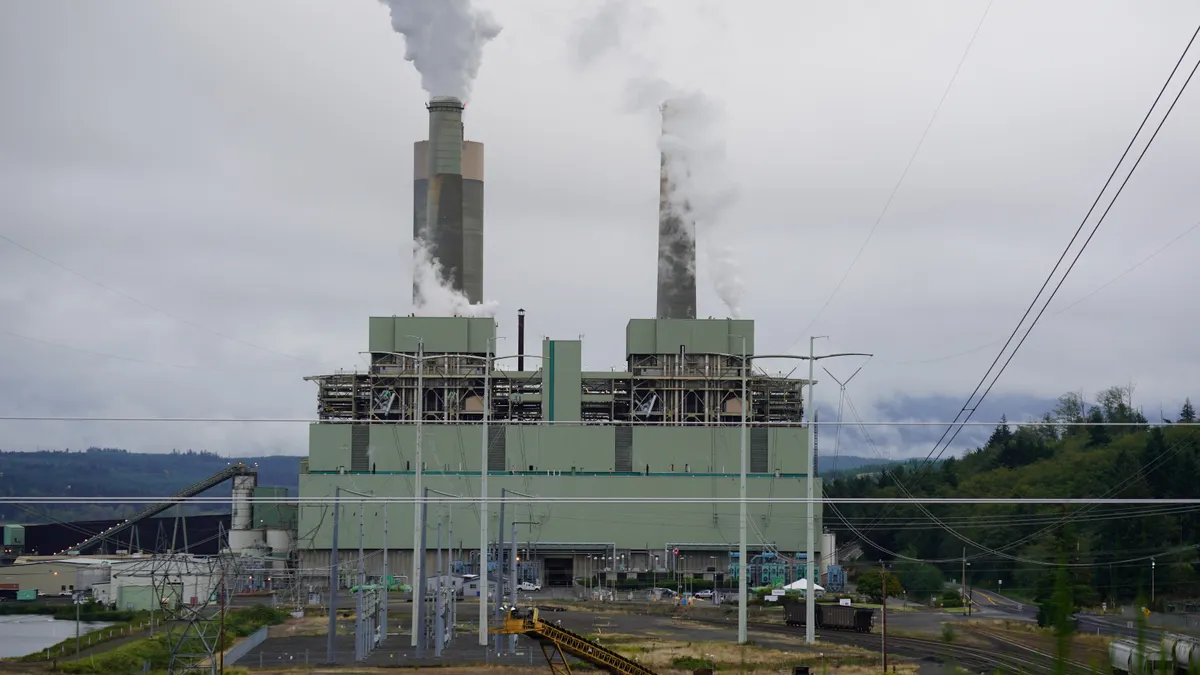
TransAlta is seeking to recover $19.9 million from ratepayers to cover its costs for keeping its 730-MW, coal-fired Centralia power plant from retiring, per U.S. Department of Energy order, according to a Thursday filing with the Federal Energy Regulatory Commission.
The power plant in Centralia, Washington, was slated for retirement on Dec. 31, 2025, “with a plan to promptly begin work to convert the unit to natural gas-fired operations,” the company said. The plant produced no electricity during the period covered by DOE’s first 90-day “emergency” order, which ended March 16. DOE issued another 90-day order the same day. The Energy Department has asserted its authority to order fossil-fueled power plants to continue operating under the Federal Power Act’s section 202(c).
In addition to its spending on fixed costs for things like materials, insurance and salaries, TransAlta, an independent power producer based in Calgary, Canada, estimates it would need to spend an additional $23 million to repair the plant if DOE issues additional emergency orders.
If the plant is called on to power up, it would incur startup costs of $577,377 per start, exclusive of the first start, which is $201,627. After startup, running the plant would cost $83.44/MWh for the first 150,866 MWh of operation and $113.49/MWh thereafter, the company said.
DOE contends the Centralia plant needs to remain open to address a grid emergency in the Northwest. In filings challenging DOE’s order, Washington’s attorney general and a coalition of groups that includes the Sierra Club say the department has failed to show that there is an emergency that justifies keeping Centralia online. The orders also put the plant in conflict with a state law requiring it to shut down by the end of 2025.
Under DOE’s orders, TransAlta was required to have the Centralia plant available to run at the direction of the Bonneville Power Administration or the California Independent System Operator through March 13. The department then ordered the plant to be available to GridForce Energy Management or the Southwest Power Pool Western Reliability Coordinator.
TransAlta said it has failed to reach an agreement with BPA, CAISO, Gridforce or SPP concerning the rates and charges the company is proposing at FERC. It has proposed two charges: a fixed charge for being available to run coupled with a variable charge if it runs. The fixed charge for the first DOE 202(c) order totals $19.9 million.
Although the filing only covers the first DOE order, TransAlta asked FERC to accept its proposed tariff with the understanding that the company will file revisions to the tariff to reflect differences in costs for future periods.
DOE has repeatedly issued additional 90-day orders for each of the six power plants it is preventing from retiring through 202(c) orders.