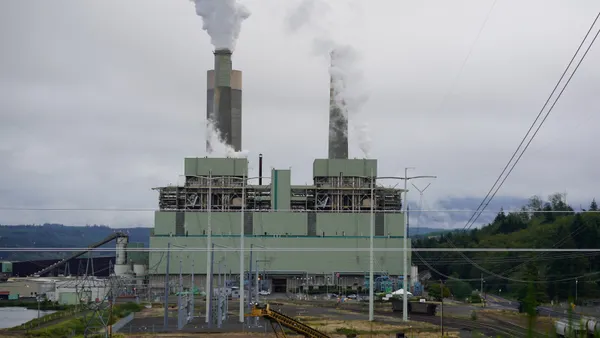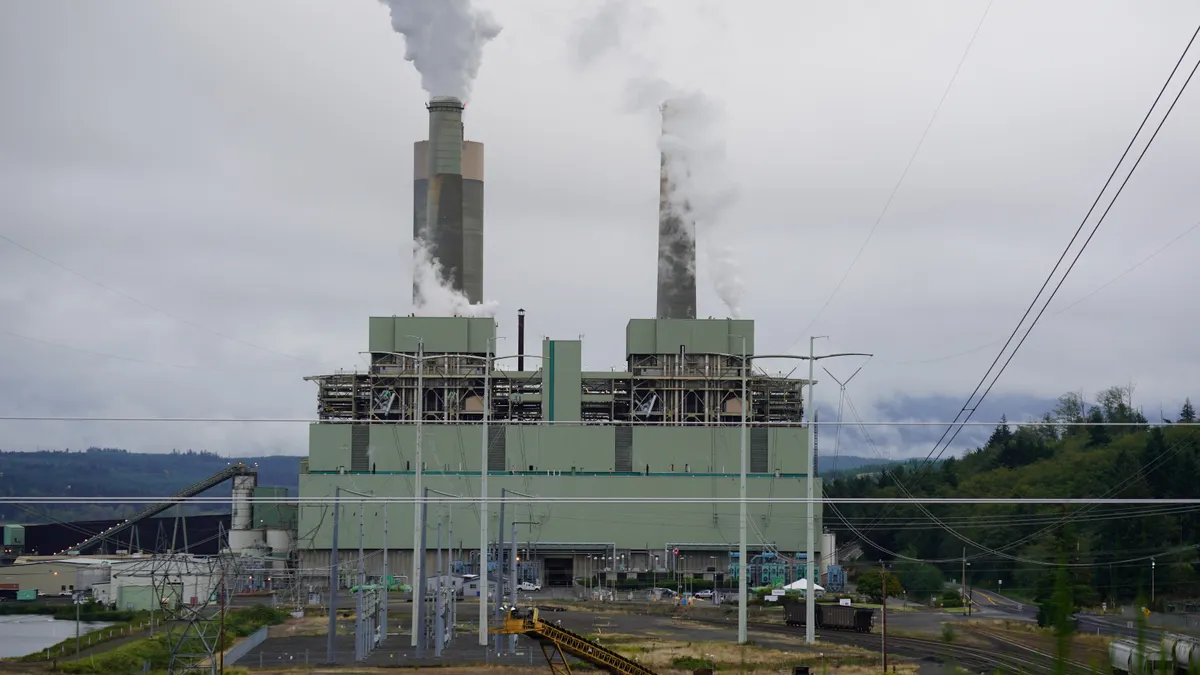
The Federal Energy Regulatory Commission on Thursday rejected TransAlta’s plan to recover its costs for keeping its 730-MW, coal-fired Centralia power plant in Washington operating under an “emergency order” from the U.S. Department of Energy.
TransAlta was seeking to recover $19.9 million in expenses related to the DOE’s first 90-day emergency order issued in mid-December, which prevented the Calgary, Canada-based company from retiring it at the end of 2025 as planned.
In its proposed cost recovery plan, TransAlta said it expected to spend an additional $23 million on repairs to keep the Centralia unit available.
FERC said TransAlta’s cost recovery plan extended too far geographically. For example, it called for recovering some costs from the California Independent System Operator and the Southwest Power Pool.
The DOE justified its emergency order directing TransAlta to keep the Centralia plant operating on the North American Electric Reliability Corp.’s 2025-2026 Winter Reliability Assessment, FERC said. In the report, NERC said the Northwest assessment area, which covers Montana, Oregon, Washington, and parts of northern California and northern Idaho, faced an “elevated risk during periods of extreme weather,” FERC noted.
If TransAlta seeks to file a revised cost recovery plan with the agency, it should only recoup costs from load-serving entities in that assessment area, FERC said.
In its decision, FERC rejected arguments that because the Centralia plant hasn’t been running under the DOE emergency order TransAlta wasn’t entitled to cost recovery. The unit has produced zero electricity this year, through July, according to the latest U.S. Energy Information Administration power production data.
“We find that the Emergency Orders’ statements that Centralia ‘shall not be considered a capacity resource’ do not preclude the commission from approving compensation for the costs that TransAlta incurred to keep Centralia operational,” FERC said.
Parties opposing TransAlta’s cost recovery plan included the Bonneville Power Administration, SPP, CAISO, Snohomish County PUD and other public power utilities, and Washington state and the Washington Utilities and Transportation Commission.
The DOE issued additional 90-day emergency orders to TransAlta under the Federal Power Act’s section 202(c) — most recently on Sept. 11.
TransAlta plans to convert the Centralia unit to burn natural gas, with the roughly $600 million, 700-MW conversion expected to be completed in the second half of 2028, according to a September investor presentation. Power from the unit would be sold to Puget Sound Energy under a 16-year agreement.
Using a novel interpretation of its authority under the Federal Power Act’s section 202(c), the DOE has issued a string of emergency orders since May 2025 to keep generating units at seven power plants from retiring — all but one of which is coal-fired.
A federal appeals court last month vacated the DOE’s first emergency order, issued to keep Consumers Energy from retiring its majority-owned Campbell power plant in Michigan. The court found that the DOE had taken an overly expansive definition of “emergency” to justify the order.
Since the Sept. 11 court decision, the DOE has reupped 202(c) orders affecting generating units owned by CenterPoint Energy, Northern Indiana Public Service Co., TransAlta, Tri-State Generation and Transmission Association, Platte River Power Authority, Salt River Project, PacifiCorp and Public Service Co. of Colorado.
It has cost about $583 million to keep the generating units under 202(c) orders from retiring, according to the Sierra Club.