Dive Brief:
- For the first time, ISO New England is including small-scale behind-the-meter battery energy storage systems in its annual system forecast, the nonprofit grid operator said last week.
- ISO-NE said the decision reflects recent and expected growth in customer-sited energy storage systems of 1 MW or less paired with solar generation. The six-state system has about 111 MW of behind-the-meter energy storage today and could see 173 MW more come online over the next 10 years, ISO-NE said.
- By 2035, ISO-NE projects small-scale behind-the-meter energy storage will reduce the region’s summer peak by 124 MW. But during the region’s expected transition from summer to winter peaking in the 2030s, uncertainty around the timing of daily load peaks could limit batteries’ ability to shift peak load, ISO-NE said.
Dive Insight:
ISO New England releases a 10-year forecast of capacity, energy, loads and transmission each spring.
This year’s forecast anticipates 9% load growth by 2035, or about 0.9% per year. The pace is slower than in the 2024 and 2025 forecasts due to policy changes that the grid operator said would slow adoption of heat pumps and electric vehicles in the near term.
ISO-NE does not expect large-scale data centers to contribute significantly to load growth over the next 10 to 15 years. It sees only 120 MW of large loads contributing to modeled peak demand of about 32.5 GW on a winter morning in 2035-36.
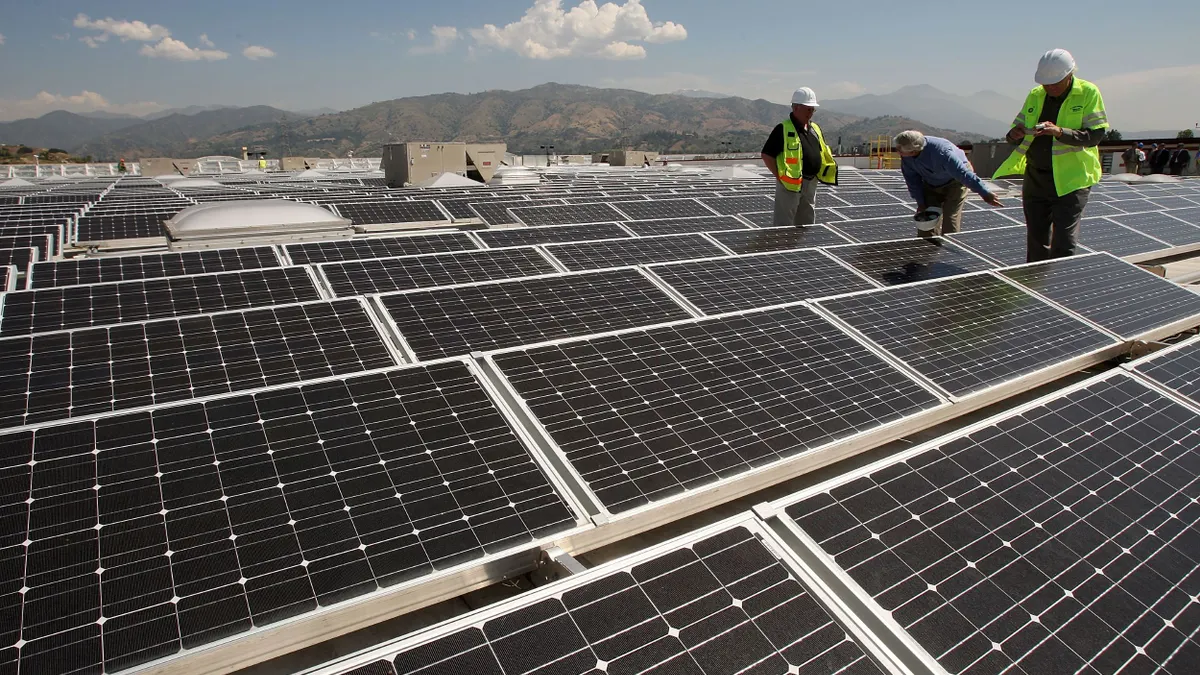
ISO-NE expects behind-the-meter solar capacity to reduce winter midday net load by 6.5 GW in 2038. However, because the daily winter peak is likely to occur shortly after sunrise, the grid operator sees behind-the-meter solar reducing net peak demand by only 750 MW during the 2035-36 cold season.
It expects behind-the-meter batteries to reduce net peak demand by an additional 121 MW, or less than 0.5%.
At issue is the inherent uncertainty of a system in transition. In the mid-2030s, winter days could see a mix of morning and evening peaks, leading some retail peak-shaving programs to instruct batteries to discharge for an anticipated daily peak that turns out to be lower than the true daily peak — for example, if evening demand proves higher than expected morning demand, ISO-NE said. The grid operator modeled equal odds that aggregated behind-the-meter batteries “miss” the peak on a given winter day in the mid-2030s, leaving them unavailable when they’re needed most.
Though ISO-NE expects behind-the-meter batteries to perform better at summer peak shaving, it sees them remaining a much smaller component of the region’s energy mix 10 years from now. It expects most of the region’s incremental capacity to come online in Massachusetts, whose average retail power rate is among the highest in the country. Earlier this year, Democratic Gov. Maura Healey said Massachusetts would aim to deploy 5 GW of battery storage capacity by 2035 on top of an existing target of 5 GW by 2030.
Additional policy support and falling system prices could push New England battery deployments higher than forecast, ISO-NE said.