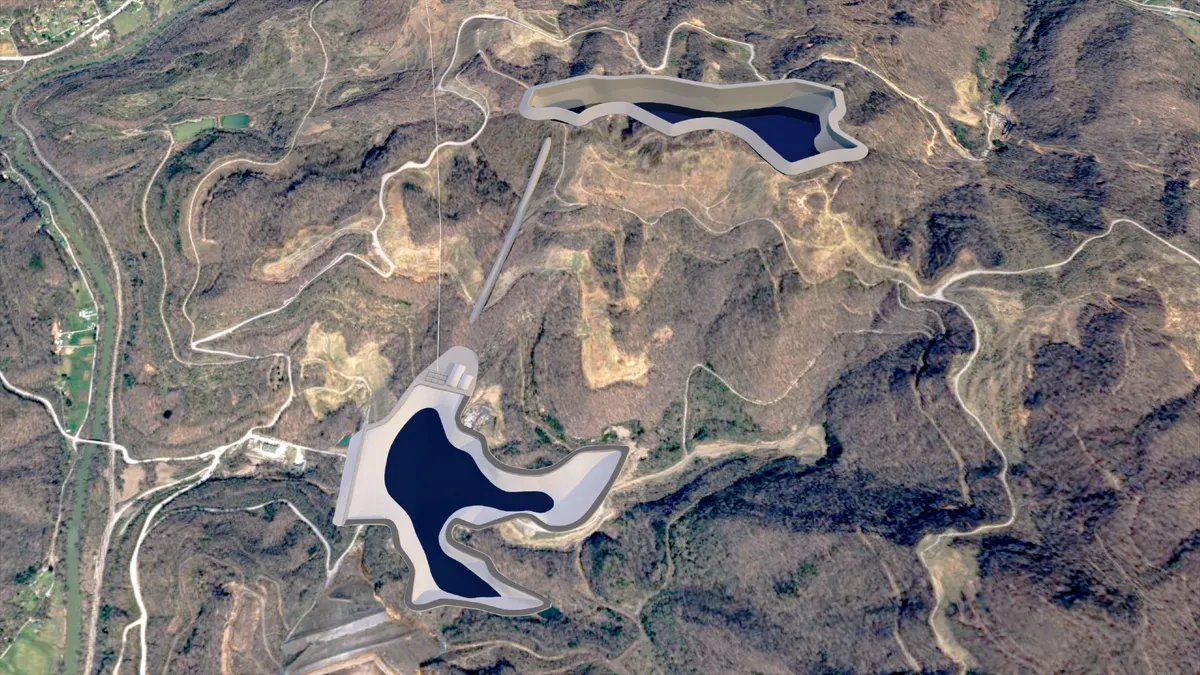
Two PPL utilities — Louisville Gas and Electric and Kentucky Utilities — are studying a proposed $1.3 billion, 266-MW pumped storage project in southeast Kentucky amid resurging interest in the old technology to meet rising demand for power.
Rye Development, a company with a number of pumped storage projects in planning, received a preliminary permit for the Lewis Ridge project from the Federal Energy Regulatory Commission in 2022. Rye filed a license application at the agency in June. It has been decades since a utility-scale pumped storage facility was built in the United States.
John Crockett III, president for LG&E and KU, called the project “a compelling initiative to explore with Rye Development because it would be the first of its kind for Kentucky and would further diversify our flexible, sustainable power generation fleet” in an April 14 press release.
As a company, Rye Development initially focused on adding generating capacity at non-powered dams, typically in the 5 MW to 10 MW range, Paul Jacob, Rye Development CEO, said in an interview with Utility Dive. But about four years ago, the company shifted its focus to pumped storage and now has seven to eight projects under development at any given time, he said.
“This is really an amazing time, really driven by AI primarily, but also increasing industrial and manufacturing demand across the country,” Jacob said. “We really see a huge market for storage of all kinds — and certainly, pumped storage is a big piece of that.”
The utilities told state regulators that if they pursue the project with Rye, they would split their ownership of the project, with KU taking a 63% stake in the project and LG&E owning 37%, according to an Aug. 11 filing with the Kentucky Public Service Commission. The utilities said they would update the ownership allocation considering their loads and resource plans if they seek permission from the agency for the closed-loop energy storage project.
However, at about $4.9 million/MW, the project doesn’t appear viable without a data center hyperscaler willing to pay for it, equity analysts with Jefferies said in an April 16 note.
The Lewis Ridge project would be built near Blackmont, Kentucky, on a former coal mine, according to the application. It would be able to produce 266 MW over eight hours by discharging water from an upper reservoir through two turbines down to a lower reservoir.
Water would be pumped back to the upper reservoir when power demand is low, typically at night. The Lewis Ridge project would draw water from the Cumberland River and Tom Fork, a tributary to the Cumberland River, for periodic recharging, according to the license application.
Rye Development expects the project could produce 60 GWh a month on average, or 717 GWh a year, according to its license application. The company said it expects to sell capacity from the project to utilities for $25/kW-month to $30/kW-month.
“Kentucky and the broader region are facing unprecedented generation retirements, mostly in the form of aging fossil-based resources,” Rye Development told FERC. “The Lewis Ridge Project allows for local utilities to take advantage of excess power on the grid when available and deploy that energy when demand is high. The project also provides necessary resource diversification in times of extreme weather events.”
If approved, Rye Development said it could begin building the project in December 2027 and bring it online about four years later.
The project would cost about $1.2 billion to build, plus about $110 million in interest costs during construction, according to the license application. The application cost about $15 million to put together, Rye Development said.
The U.S. Department of Energy’s Office of Clean Energy Demonstration awarded the project $81 million in funding for clean energy projects on mine lands, according to Rye Development.
Rye Development is developing more than 4 GW of U.S. pumped storage projects, according to the company. It is backed by EDF Power Solutions and Climate Adaptive Infrastructure.
FERC in December approved a 1.2-GW pumped storage project planned by Rye Development with the backing of Copenhagen Infrastructure Partners. The project is set to be built at a former aluminum smelter near Goldendale, Washington, and would generate electricity for up to 12 hours, according to Rye.
Rye shifts to pumped storage as markets evolve
The needs for large-scale storage vary by region, according to Jacob. In the West, the need is driven by renewable energy integration and reliability benefits, he said.
In the East, it can be used to meet load growth, but also to smooth out the use of fossil-fueled generation instead of ramping them up and down, he said.
Beside acting as a peaking power plant — providing electricity when demand is highest — pumped storage can provide a range of ancillary benefits, including providing inertia for the grid, Jacob said.
During extreme weather events, when gas usage and prices are high, pumped storage projects can provide power untethered to those fuel costs, he noted.
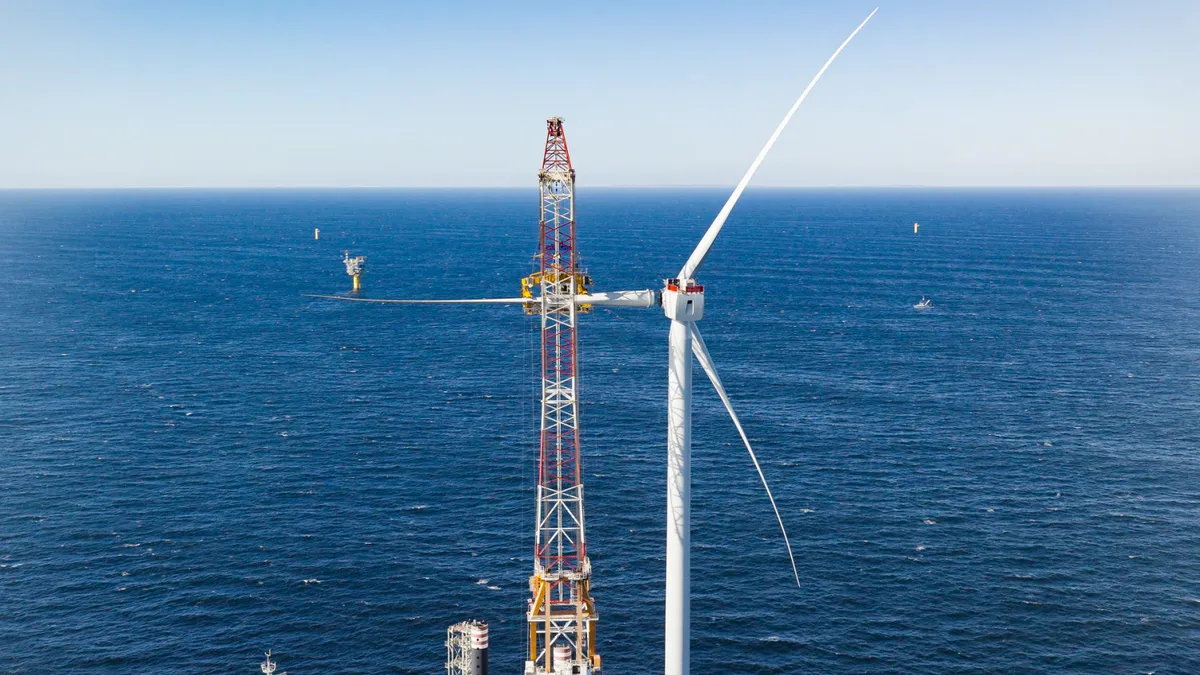
Although a pumped storage project hasn’t been built in roughly 30 years, pumped storage doesn’t face construction risks like new nuclear or offshore wind, according to Jacob.
Pumped storage projects involve building reservoirs, building a conveyance system — either penstocks or tunnels — and a powerhouse.
“There's nothing novel about any of those parts of it,” Jacob said.
Currently, there is about 20.1 GW of pumped storage capacity in the United States.
FERC is reviewing license applications totaling 2.7 GW for new pumped storage projects in Nevada, California, Kentucky and Wyoming, according to the agency.
It has issued preliminary permits — a permit that allows a company to explore a hydroelectric project before seeking a license — totaling 47.8 GW, and the agency is considering preliminary pumped storage permit applications totaling 304.2 GW, including 300 GW in western Virginia.