Dive Brief:
- As interest rates continue to rise, utilities may shift the mix of tools and instruments they use to finance their capital plans, which are also continuing to grow, said Tim Keller, managing director of U.S. Bank’s power and utilities group, in an interview with Utility Dive.
- “If we see rates drift higher for longer,” Keller said he expects utilities may increasingly use convertible debt — a type of bond which the investor can later exchange for stock. In addition to adapting to higher interest rates, Keller noted that U.S. Bank’s power and utility clients have faced an “adjustment” as the Iran War has continued and fuel prices have remained high, he said.
- Power and utility CFOs seemed a “little bit” more cautious compared with other respondents to U.S. Bank’s Fall 2026 survey of CFOs, Keller said. Power and utility companies must manage both shareholders, who want to see growth, as well as ratepayers and consumers, who want that growth to be well-balanced, he noted.
Dive Insight:
U.S. utilities “exhibit a pronounced sensitivity to interest rate movements,” according to 2025 analysis from investment firm Redwheel, though the analysis said independent power producers like Vistra, Constellation Energy and Talen Energy “have largely bucked the trend.”
“With their business models built on long-term, regulated cash flows and capital-intensive infrastructure, higher rates raise the cost of debt and reduce the present value of future earnings,” Redwheel said.
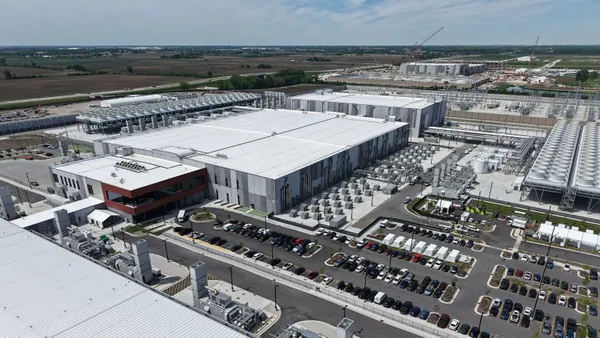
“What's interesting in my mind is the amount of capital” utilities are deploying, Keller said. “This has always been a very capital-intensive sector, and that's increasingly the case as capital plans have been ratcheted higher year over year for the last couple years, as a lot of our utility clients are seizing on the AI-driven data center opportunity.”
However, he added, capital expenditure “has been, to date, really well-balanced by our clients, in terms of a sensitivity to capital structure and ensuring that they're staying onsides of their credit metrics. That's going to be a little more challenging with rates going higher as quickly as they have.”
The Federal Reserve raised its benchmark interest rate on Sept. 16 from 3.75% to 4% — the central bank’s first rate hike since 2023. In addition, bond yields are “soaring,” according to William B. English, a finance professor at the Yale School of Management; last week the 10-year yield rose above 5.6% for the first time since 2002.
Keller noted that as the U.S. Department of Energy has pulled back from fulfilling loans for certain projects, he’s seen utilities approach banks seeking backup project financing in case DOE financing doesn’t come through. “I think you're going to see more of that,” he said.
Continuing geopolitical pressures
Keller said that U.S. Bank has been “really, really positively surprised at the resiliency that we've seen in the economy generally, and then, even within the power and utility sector, as we've seen capital market transactions get larger and larger.”
So far, he said, “the demand has been there for the supply, and we need that to continue because the plans continue to get adjusted higher.”
Despite continued geopolitical risk, U.S. Bank’s survey of CFOs across various sectors found growing optimism. Around 68% of them rated their three-year outlook as positive, compared with only 58% who were surveyed in March and April. “Shorter-term confidence climbed, too: 41% rate their 12-month outlook as positive, a 5-percentage-point increase since the spring,” the survey said.
Geopolitical risks were a top concern for 38% of the surveyed CFOs, above high borrowing costs, at 35%, and inflation, at 34%. Keller said he thinks the war in Iran was a factor for power and utility respondents in particular.
“There was a lot in the press over the last year around our higher fuel costs being transitory,” he said. “Once the Strait of Hormuz opens, would we see oil prices in particular fall back to more normalized levels, and as a result, would we see the hot inflation prints also fall in tandem?” he said. This scenario “hasn't exactly played out as quickly as expected.”
This sticky inflation has implications for utilities, he said, as they pursue the financial opportunities offered by data center growth.
“We've seen a pause in certain jurisdictions as it relates to what would have initially been, I think, a warm embrace of data center plans providing growth for utilities,” Keller said. “Now, the growth opportunity still exists, but that growth opportunity needs to be managed in a way that is constructive for all parties.”
However, he said, “I think there's still a recognition that there's a good growth story, a better growth story than had been the case for the last couple decades, and the pause that we've seen around data center sentiment is hopefully more temporary than permanent.”
Keller also noted that sentiment around mergers and acquisitions seemed “a little different” than it had been in the spring and the summer. He noted that no significant consolidation deals have been announced since NextEra announced its plans to acquire Dominion Energy in May.
M&A conversations are complicated by the “very hard-to-predict geopolitical environment” and, “frankly, very hard-to-predict interest rate environment. And interest rates clearly are in every CFO's mind as they're contemplating M&A, and financing costs certainly ... Utility M&A is notoriously difficult.”